Question 8
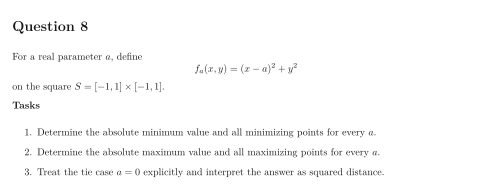
For a real parameter , define on the square .
Tasks
Determine the absolute minimum value and all minimizing points for every .
Determine the absolute maximum value and all maximizing points for every .
Treat the tie case explicitly and interpret the answer as squared distance.
Show solutionHide solution
Question 8 – Solution
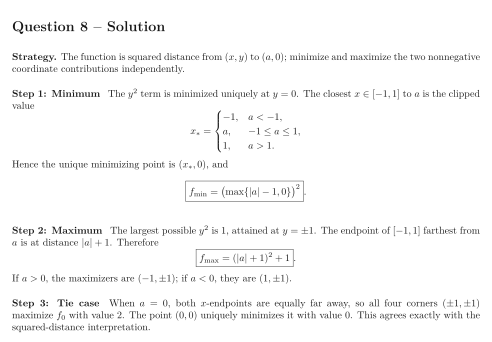
Strategy. The function is squared distance from to ; minimize and maximize the two nonnegative coordinate contributions independently.
Step 1: Minimum The term is minimized uniquely at . The closest to is the clipped value Hence the unique minimizing point is , and
Step 2: Maximum The largest possible is , attained at . The endpoint of farthest from is at distance . Therefore If , the maximizers are ; if , they are .
Step 3: Tie case When , both -endpoints are equally far away, so all four corners maximize with value . The point uniquely minimizes it with value . This agrees exactly with the squared-distance interpretation.