Absolute Minimums and Maximums — Question 4

PDF ↗

Question 4

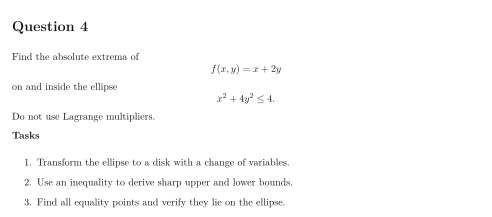
Find the absolute extrema of f(x,y)=x+2yf(x,y)=x+2y on and inside the ellipse x2+4y2≤4.x^2+4y^2\le 4. Do not use Lagrange multipliers.

Tasks

  1. Transform the ellipse to a disk with a change of variables.

  2. Use an inequality to derive sharp upper and lower bounds.

  3. Find all equality points and verify they lie on the ellipse.
Original worksheet page 1: question and worked solution for 3-4-004
Show solutionHide solution

Question 4 – Solution

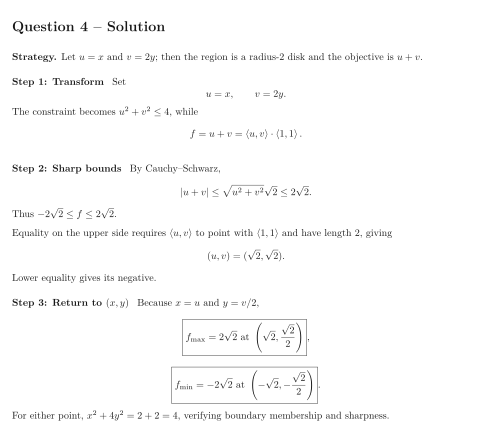
Strategy. Let u=xu=x and v=2yv=2y; then the region is a radius-22 disk and the objective is u+vu+v.

Step 1: Transform Set u=x,v=2y.u=x,\qquad v=2y. The constraint becomes u2+v2≤4u^2+v^2\le 4, while f=u+v=⟨u,v⟩⋅⟨1,1⟩.f=u+v=\left\langle u,v\right\rangle\cdot\left\langle 1,1\right\rangle.

Step 2: Sharp bounds By Cauchy–Schwarz, |u+v|≤u2+v22≤22.|u+v|\le\sqrt{u^2+v^2}\sqrt 2\le 2\sqrt 2. Thus −22≤f≤22-2\sqrt 2\le f\le 2\sqrt 2.

Equality on the upper side requires ⟨u,v⟩\left\langle u,v\right\rangle to point with ⟨1,1⟩\left\langle 1,1\right\rangle and have length 22, giving (u,v)=(2,2).(u,v)=(\sqrt 2,\sqrt 2). Lower equality gives its negative.

Step 3: Return to (x,y)(x,y) Because x=ux=u and y=v/2y=v/2, fmax=22 at (2,22),\boxed{f_{\max}=2\sqrt 2\text{ at }\left(\sqrt 2,\frac{\sqrt 2}{2}\right)}, fmin=−22 at (−2,−22).\boxed{f_{\min}=-2\sqrt 2\text{ at }\left(-\sqrt 2,-\frac{\sqrt 2}{2}\right)}. For either point, x2+4y2=2+2=4x^2+4y^2=2+2=4, verifying boundary membership and sharpness.
Original worksheet page 2: question and worked solution for 3-4-004

Original worksheet layout. Use Enlarge or open the PDF for a closer view.