Question 8
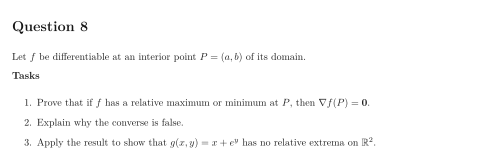
Let be differentiable at an interior point of its domain.
Tasks
Prove that if has a relative maximum or minimum at , then .
Explain why the converse is false.
Apply the result to show that has no relative extrema on .
Show solutionHide solution
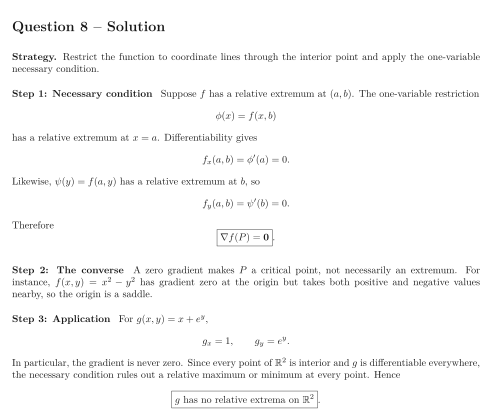
Question 8 – Solution
Strategy. Restrict the function to coordinate lines through the interior point and apply the one-variable necessary condition.
Step 1: Necessary condition Suppose has a relative extremum at . The one-variable restriction has a relative extremum at . Differentiability gives Likewise, has a relative extremum at , so Therefore
Step 2: The converse A zero gradient makes a critical point, not necessarily an extremum. For instance, has gradient zero at the origin but takes both positive and negative values nearby, so the origin is a saddle.
Step 3: Application For , In particular, the gradient is never zero. Since every point of is interior and is differentiable everywhere, the necessary condition rules out a relative maximum or minimum at every point. Hence