Relative Minimums and Maximums — Question 6

PDF ↗

Question 6

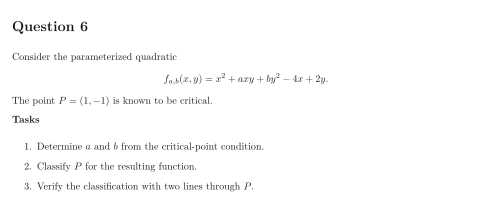
Consider the parameterized quadratic fa,b(x,y)=x2+axy+by2−4x+2y.f_{a,b}(x,y)=x^2+axy+by^2-4x+2y. The point P=(1,−1)P=(1,-1) is known to be critical.

Tasks

  1. Determine aa and bb from the critical-point condition.

  2. Classify PP for the resulting function.

  3. Verify the classification with two lines through PP.

Original worksheet page 1: question and worked solution for 3-3-006
Show solutionHide solution

Question 6 – Solution

Strategy. Use the two first-derivative equations to reconstruct the parameters, then test the resulting quadratic form around PP.

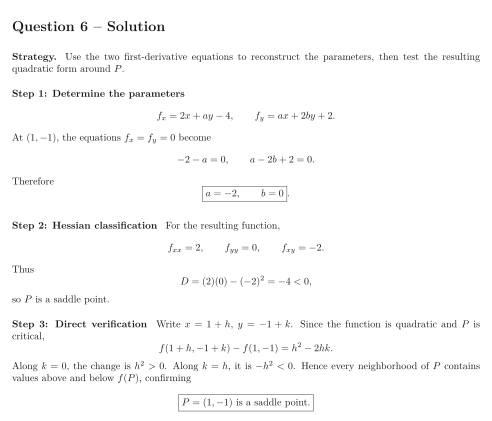
Step 1: Determine the parameters fx=2x+ay−4,fy=ax+2by+2.f_x=2x+ay-4,\qquad f_y=ax+2by+2. At (1,−1)(1,-1), the equations fx=fy=0f_x=f_y=0 become −2−a=0,a−2b+2=0.-2-a=0,\qquad a-2b+2=0. Therefore a=−2,b=0.\boxed{a=-2,\qquad b=0}.

Step 2: Hessian classification For the resulting function, fxx=2,fyy=0,fxy=−2.f_{xx}=2,\qquad f_{yy}=0,\qquad f_{xy}=-2. Thus D=(2)(0)−(−2)2=−4<0,D=(2)(0)-(-2)^2=-4<0, so PP is a saddle point.

Step 3: Direct verification Write x=1+hx=1+h, y=−1+ky=-1+k. Since the function is quadratic and PP is critical, f(1+h,−1+k)−f(1,−1)=h2−2hk.f(1+h,-1+k)-f(1,-1)=h^2-2hk. Along k=0k=0, the change is h2>0h^2>0. Along k=hk=h, it is −h2<0-h^2<0. Hence every neighborhood of PP contains values above and below f(P)f(P), confirming P=(1,−1) is a saddle point.\boxed{P=(1,-1)\text{ is a saddle point}.}

Original worksheet page 2: question and worked solution for 3-3-006

Original worksheet layout. Use Enlarge or open the PDF for a closer view.