Gradient Vector, Tangent Planes and Normal Lines — Question 1

PDF ↗

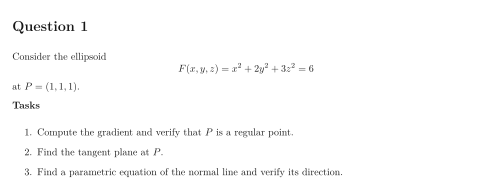
Question 1

Consider the ellipsoid F(x,y,z)=x2+2y2+3z2=6F(x,y,z)=x^2+2y^2+3z^2=6 at P=(1,1,1)P=(1,1,1).

Tasks

  1. Compute the gradient and verify that PP is a regular point.

  2. Find the tangent plane at PP.

  3. Find a parametric equation of the normal line and verify its direction.
Original worksheet page 1: question and worked solution for 3-2-001
Show solutionHide solution

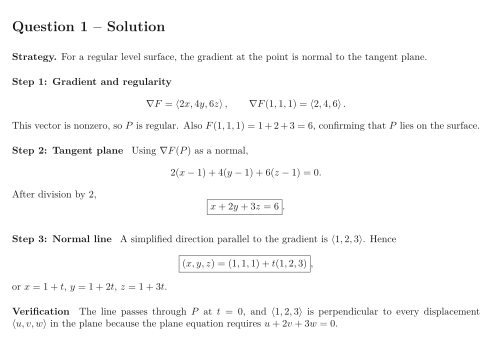
Question 1 – Solution

Strategy. For a regular level surface, the gradient at the point is normal to the tangent plane.

Step 1: Gradient and regularity ∇F=⟨2x,4y,6z⟩,∇F(1,1,1)=⟨2,4,6⟩.\nabla F=\left\langle 2x,4y,6z\right\rangle, \qquad \nabla F(1,1,1)=\left\langle 2,4,6\right\rangle. This vector is nonzero, so PP is regular. Also F(1,1,1)=1+2+3=6F(1,1,1)=1+2+3=6, confirming that PP lies on the surface.

Step 2: Tangent plane Using ∇F(P)\nabla F(P) as a normal, 2(x−1)+4(y−1)+6(z−1)=0.2(x-1)+4(y-1)+6(z-1)=0. After division by 22, x+2y+3z=6.\boxed{x+2y+3z=6}.

Step 3: Normal line A simplified direction parallel to the gradient is ⟨1,2,3⟩\left\langle 1,2,3\right\rangle. Hence (x,y,z)=(1,1,1)+t(1,2,3),\boxed{(x,y,z)=(1,1,1)+t(1,2,3)}, or x=1+tx=1+t, y=1+2ty=1+2t, z=1+3tz=1+3t.

Verification The line passes through PP at t=0t=0, and ⟨1,2,3⟩\left\langle 1,2,3\right\rangle is perpendicular to every displacement ⟨u,v,w⟩\left\langle u,v,w\right\rangle in the plane because the plane equation requires u+2v+3w=0u+2v+3w=0.

Original worksheet page 2: question and worked solution for 3-2-001

Original worksheet layout. Use Enlarge or open the PDF for a closer view.