Tangent Planes and Linear Approximations — Question 6

PDF ↗

Question 6

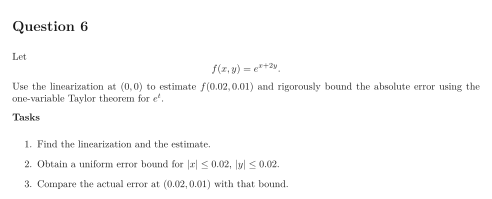
Let f(x,y)=ex+2y.f(x,y)=e^{x+2y}. Use the linearization at (0,0)(0,0) to estimate f(0.02,0.01)f(0.02,0.01) and rigorously bound the absolute error using the one-variable Taylor theorem for ete^t.

Tasks

  1. Find the linearization and the estimate.

  2. Obtain a uniform error bound for |x|≤0.02|x|\le 0.02, |y|≤0.02|y|\le 0.02.

  3. Compare the actual error at (0.02,0.01)(0.02,0.01) with that bound.

Original worksheet page 1: question and worked solution for 3-1-006
Show solutionHide solution

Question 6 – Solution

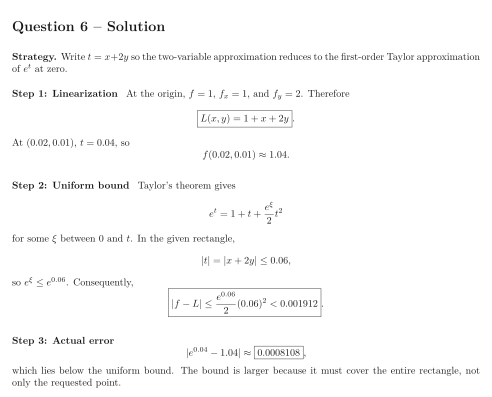
Strategy. Write t=x+2yt=x+2y so the two-variable approximation reduces to the first-order Taylor approximation of ete^t at zero.

Step 1: Linearization At the origin, f=1f=1, fx=1f_x=1, and fy=2f_y=2. Therefore L(x,y)=1+x+2y.\boxed{L(x,y)=1+x+2y}. At (0.02,0.01)(0.02,0.01), t=0.04t=0.04, so f(0.02,0.01)≈1.04.f(0.02,0.01)\approx 1.04.

Step 2: Uniform bound Taylor’s theorem gives et=1+t+eξ2t2e^t=1+t+\frac{e^\xi}{2}t^2 for some ξ\xi between 00 and tt. In the given rectangle, |t|=|x+2y|≤0.06,|t|=|x+2y|\le 0.06, so eξ≤e0.06e^\xi\le e^{0.06}. Consequently, |f−L|≤e0.062(0.06)2<0.001912.\boxed{|f-L|\le\frac{e^{0.06}}2(0.06)^2<0.001912}.

Step 3: Actual error |e0.04−1.04|≈0.0008108,|e^{0.04}-1.04|\approx\boxed{0.0008108}, which lies below the uniform bound. The bound is larger because it must cover the entire rectangle, not only the requested point.
Original worksheet page 2: question and worked solution for 3-1-006

Original worksheet layout. Use Enlarge or open the PDF for a closer view.