Directional Derivatives — Question 9

PDF ↗

Question 9

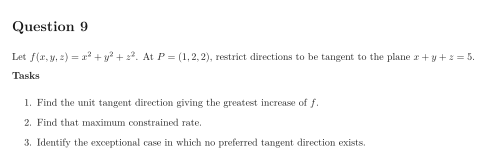
Let f(x,y,z)=x2+y2+z2f(x,y,z)=x^2+y^2+z^2. At P=(1,2,2)P=(1,2,2), restrict directions to be tangent to the plane x+y+z=5x+y+z=5.

Tasks

  1. Find the unit tangent direction giving the greatest increase of ff.

  2. Find that maximum constrained rate.

  3. Identify the exceptional case in which no preferred tangent direction exists.
Original worksheet page 1: question and worked solution for 2-7-009
Show solutionHide solution

Question 9 – Solution

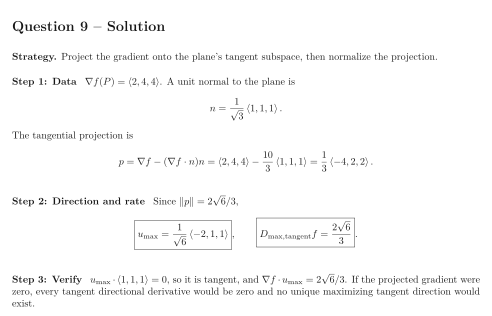
Strategy. Project the gradient onto the plane’s tangent subspace, then normalize the projection.

Step 1: Data ∇f(P)=⟨2,4,4⟩\nabla f(P)=\left\langle 2,4,4\right\rangle. A unit normal to the plane is n=13⟨1,1,1⟩.n=\frac 1{\sqrt 3}\left\langle 1,1,1\right\rangle. The tangential projection is p=∇f−(∇f⋅n)n=⟨2,4,4⟩−103⟨1,1,1⟩=13⟨−4,2,2⟩.p=\nabla f-(\nabla f\cdot n)n =\left\langle 2,4,4\right\rangle-\frac{10}{3}\left\langle 1,1,1\right\rangle =\frac 13\left\langle-4,2,2\right\rangle.

Step 2: Direction and rate Since ∥p∥=26/3\|p\|=2\sqrt 6/3, umax=16⟨−2,1,1⟩,Dmax⁡,tangentf=263.\boxed{u_{\max}=\frac 1{\sqrt 6}\left\langle-2,1,1\right\rangle},\qquad \boxed{D_{\max,\mathrm{tangent}}f=\frac{2\sqrt 6}{3}}.

Step 3: Verify umax⋅⟨1,1,1⟩=0u_{\max}\cdot\left\langle 1,1,1\right\rangle=0, so it is tangent, and ∇f⋅umax=26/3\nabla f\cdot u_{\max}=2\sqrt 6/3. If the projected gradient were zero, every tangent directional derivative would be zero and no unique maximizing tangent direction would exist.
Original worksheet page 2: question and worked solution for 2-7-009

Original worksheet layout. Use Enlarge or open the PDF for a closer view.