Directional Derivatives — Question 7

PDF ↗

Question 7

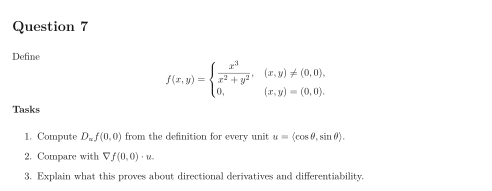
Define f(x,y)={x3x2+y2,(x,y)≠(0,0),0,(x,y)=(0,0).f(x,y)= \begin{cases} \dfrac{x^3}{x^2+y^2},&(x,y)\ne(0,0),\\ 0,&(x,y)=(0,0). \end{cases} Tasks

  1. Compute Duf(0,0)D_{u}f(0,0) from the definition for every unit u=⟨cosθ,sinθ⟩u=\left\langle\cos\theta,\sin\theta\right\rangle.

  2. Compare with ∇f(0,0)⋅u\nabla f(0,0)\cdot u.

  3. Explain what this proves about directional derivatives and differentiability.
Original worksheet page 1: question and worked solution for 2-7-007
Show solutionHide solution

Question 7 – Solution

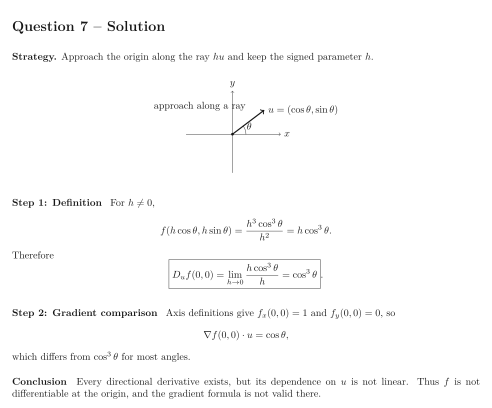
Strategy. Approach the origin along the ray huhu and keep the signed parameter hh.

See the diagram in the original worksheet below.

Step 1: Definition For h≠0h\ne 0, f(hcos⁡θ,hsin⁡θ)=h3cos⁡3θh2=hcos⁡3θ.f(h\cos\theta,h\sin\theta) =\frac{h^3\cos^3\theta}{h^2} =h\cos^3\theta. Therefore Duf(0,0)=limh→0hcos⁡3θh=cos⁡3θ.\boxed{D_{u}f(0,0)=\lim_{h\to 0}\frac{h\cos^3\theta}{h} =\cos^3\theta}.

Step 2: Gradient comparison Axis definitions give fx(0,0)=1f_x(0,0)=1 and fy(0,0)=0f_y(0,0)=0, so ∇f(0,0)⋅u=cos⁡θ,\nabla f(0,0)\cdot u=\cos\theta, which differs from cos⁡3θ\cos^3\theta for most angles.

Conclusion Every directional derivative exists, but its dependence on uu is not linear. Thus ff is not differentiable at the origin, and the gradient formula is not valid there.
Original worksheet page 2: question and worked solution for 2-7-007

Original worksheet layout. Use Enlarge or open the PDF for a closer view.