Chain Rule — Question 9

PDF ↗

Question 9

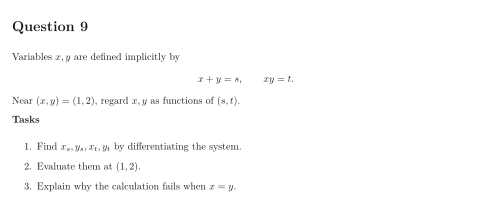
Variables x,yx,y are defined implicitly by x+y=s,xy=t.x+y=s,\qquad xy=t. Near (x,y)=(1,2)(x,y)=(1,2), regard x,yx,y as functions of (s,t)(s,t).

Tasks

  1. Find xs,ys,xt,ytx_s,y_s,x_t,y_t by differentiating the system.

  2. Evaluate them at (1,2)(1,2).

  3. Explain why the calculation fails when x=yx=y.

Original worksheet page 1: question and worked solution for 2-6-009
Show solutionHide solution

Question 9 – Solution

Strategy. Differentiate both constraints and solve the resulting 2×22\times 2 linear systems.

Step 1: With respect to ss xs+ys=1,yxs+xys=0.x_s+y_s=1,\qquad yx_s+xy_s=0. Solving gives xs=xx−y,ys=−yx−y.\boxed{x_s=\frac{x}{x-y}},\qquad\boxed{y_s=-\frac{y}{x-y}}.

Step 2: With respect to tt xt+yt=0,yxt+xyt=1,x_t+y_t=0,\qquad yx_t+xy_t=1, so xt=1y−x,yt=1x−y.\boxed{x_t=\frac 1{y-x}},\qquad\boxed{y_t=\frac 1{x-y}}. At (1,2)(1,2): xs=−1,ys=2,xt=1,yt=−1.\boxed{x_s=-1,\ y_s=2,\ x_t=1,\ y_t=-1}.

Step 3: Edge case The determinant of the coefficient matrix is x−yx-y. When x=yx=y, the system cannot locally distinguish the two roots; division by x−yx-y correctly signals failure of this local inverse description.
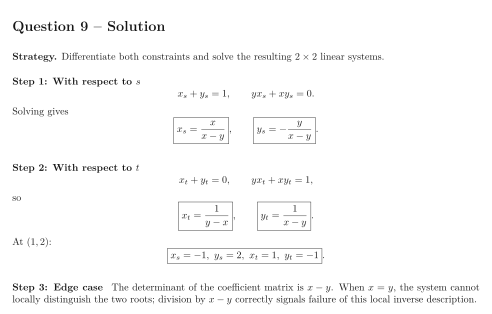
Original worksheet page 2: question and worked solution for 2-6-009

Original worksheet layout. Use Enlarge or open the PDF for a closer view.