Differentials — Question 3

PDF ↗

Question 3

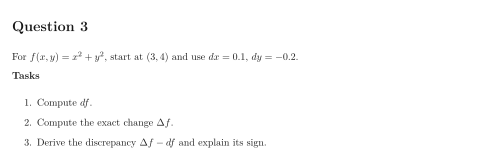
For f(x,y)=x2+y2f(x,y)=x^2+y^2, start at (3,4)(3,4) and use dx=0.1dx=0.1, dy=−0.2dy=-0.2.

Tasks

  1. Compute dfdf.

  2. Compute the exact change Δf\Delta f.

  3. Derive the discrepancy Δf−df\Delta f-df and explain its sign.

Original worksheet page 1: question and worked solution for 2-5-003
Show solutionHide solution

Question 3 – Solution

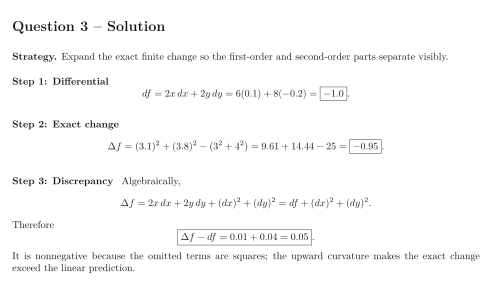
Strategy. Expand the exact finite change so the first-order and second-order parts separate visibly.

Step 1: Differential df=2xdx+2ydy=6(0.1)+8(−0.2)=−1.0.df=2x\,dx+2y\,dy=6(0.1)+8(-0.2)=\boxed{-1.0}.

Step 2: Exact change Δf=(3.1)2+(3.8)2−(32+42)=9.61+14.44−25=−0.95.\Delta f=(3.1)^2+(3.8)^2-(3^2+4^2)=9.61+14.44-25=\boxed{-0.95}.

Step 3: Discrepancy Algebraically, Δf=2xdx+2ydy+(dx)2+(dy)2=df+(dx)2+(dy)2.\Delta f=2x\,dx+2y\,dy+(dx)^2+(dy)^2 =df+(dx)^2+(dy)^2. Therefore Δf−df=0.01+0.04=0.05.\boxed{\Delta f-df=0.01+0.04=0.05}. It is nonnegative because the omitted terms are squares; the upward curvature makes the exact change exceed the linear prediction.

Original worksheet page 2: question and worked solution for 2-5-003

Original worksheet layout. Use Enlarge or open the PDF for a closer view.