Limits — Question 10

PDF ↗

Question 10

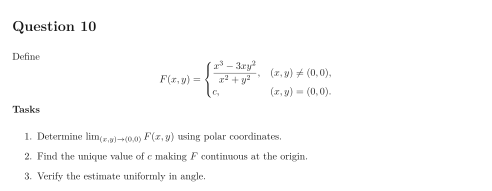
Define F(x,y)={x3−3xy2x2+y2,(x,y)≠(0,0),c,(x,y)=(0,0).F(x,y)= \begin{cases} \dfrac{x^3-3xy^2}{x^2+y^2},&(x,y)\ne(0,0),\\ c,&(x,y)=(0,0). \end{cases} Tasks

  1. Determine lim⁡(x,y)→(0,0)F(x,y)\lim_{(x,y)\to(0,0)}F(x,y) using polar coordinates.

  2. Find the unique value of cc making FF continuous at the origin.

  3. Verify the estimate uniformly in angle.
Original worksheet page 1: question and worked solution for 2-1-010
Show solutionHide solution

Question 10 – Solution

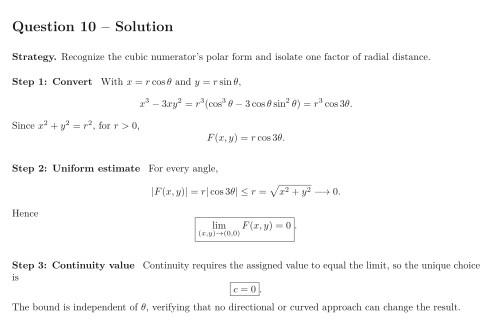
Strategy. Recognize the cubic numerator’s polar form and isolate one factor of radial distance.

Step 1: Convert With x=rcos⁡θx=r\cos\theta and y=rsin⁡θy=r\sin\theta, x3−3xy2=r3(cos⁡3θ−3cos⁡θsin⁡2θ)=r3cos⁡3θ.x^3-3xy^2=r^3(\cos^3\theta-3\cos\theta\sin^2\theta)=r^3\cos 3\theta. Since x2+y2=r2x^2+y^2=r^2, for r>0r>0, F(x,y)=rcos⁡3θ.F(x,y)=r\cos 3\theta.

Step 2: Uniform estimate For every angle, |F(x,y)|=r|cos⁡3θ|≤r=x2+y2→0.|F(x,y)|=r|\cos 3\theta|\le r=\sqrt{x^2+y^2}\longrightarrow 0. Hence lim(x,y)→(0,0)F(x,y)=0.\boxed{\displaystyle\lim_{(x,y)\to(0,0)}F(x,y)=0}.

Step 3: Continuity value Continuity requires the assigned value to equal the limit, so the unique choice is c=0.\boxed{c=0}. The bound is independent of θ\theta, verifying that no directional or curved approach can change the result.
Original worksheet page 2: question and worked solution for 2-1-010

Original worksheet layout. Use Enlarge or open the PDF for a closer view.