Arc Length with Vector Functions β€” Question 10

PDF β†—

Question 10

Let 𝒓:[a,b]→ℝ3\mathbf r:[a,b]\to\mathbb R^3 be continuously differentiable.

Tasks

  1. Prove the chord–arc inequality βˆ₯𝒓(b)βˆ’π’“(a)βˆ₯β‰€βˆ«abβˆ₯𝒓′(t)βˆ₯dt.\|\mathbf r(b)-\mathbf r(a)\|\le\int_a^b\|\mathbf r'(t)\|\,dt.

  2. Give a clear geometric interpretation.

  3. Show that equality holds if 𝒓′(t)=Ξ»(t)𝒖\mathbf r'(t)=\lambda(t)\mathbf u, where 𝒖\mathbf u is fixed unit vector and Ξ»(t)β‰₯0\lambda(t)\ge 0.

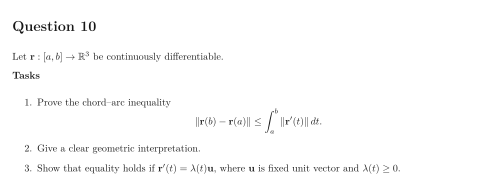
Original worksheet page 1: question and worked solution for 1-9-010
Show solutionHide solution

Question 10 – Solution

Strategy. Express displacement as the integral of the velocity vector and apply a dot-product estimate in the displacement direction.

Step 1: Zero-displacement case If 𝒓(b)=𝒓(a)\mathbf r(b)=\mathbf r(a), the left side is zero and the inequality follows because the integral of speed is nonnegative.

Now suppose 𝒅=𝒓(b)βˆ’π’“(a)β‰ πŸŽ\mathbf d=\mathbf r(b)-\mathbf r(a)\ne\mathbf 0 and define the unit vector 𝒖=𝒅/βˆ₯𝒅βˆ₯\mathbf u=\mathbf d/\|\mathbf d\|.

Step 2: Use the Fundamental Theorem 𝒅=∫ab𝒓′(t)dt.\mathbf d=\int_a^b\mathbf r'(t)\,dt. Dot both sides with 𝒖\mathbf u: βˆ₯𝒅βˆ₯=𝒅⋅𝒖=∫ab𝒓′(t)⋅𝒖dtβ‰€βˆ«ab|𝒓′(t)⋅𝒖|dtβ‰€βˆ«abβˆ₯𝒓′(t)βˆ₯βˆ₯𝒖βˆ₯dt=∫abβˆ₯𝒓′(t)βˆ₯dt.\begin{align*} \|\mathbf d\| &=\mathbf d\cdot\mathbf u\\ &=\int_a^b\mathbf r'(t)\cdot\mathbf u\,dt\\ &\le\int_a^b|\mathbf r'(t)\cdot\mathbf u|\,dt\\ &\le\int_a^b\|\mathbf r'(t)\|\,\|\mathbf u\|\,dt\\ &=\int_a^b\|\mathbf r'(t)\|\,dt. \end{align*} Therefore βˆ₯𝒓(b)βˆ’π’“(a)βˆ₯β‰€βˆ«abβˆ₯𝒓′(t)βˆ₯dt.\boxed{\|\mathbf r(b)-\mathbf r(a)\|\le \int_a^b\|\mathbf r'(t)\|\,dt}.

Step 3: Geometry and equality The straight chord is the shortest connection between the endpoints; following a curved or reversing path cannot be shorter. If 𝒓′=λ𝒖\mathbf r'=\lambda\mathbf u with Ξ»β‰₯0\lambda\ge 0, then 𝒓(b)βˆ’π’“(a)=π’–βˆ«abΞ»(t)dt,\mathbf r(b)-\mathbf r(a)=\mathbf u\int_a^b\lambda(t)\,dt, so its norm is ∫abΞ»(t)dt\int_a^b\lambda(t)dt. Meanwhile βˆ₯𝒓′βˆ₯=Ξ»\|\mathbf r'\|=\lambda, giving equality. The condition describes travel in one fixed direction without backtracking.
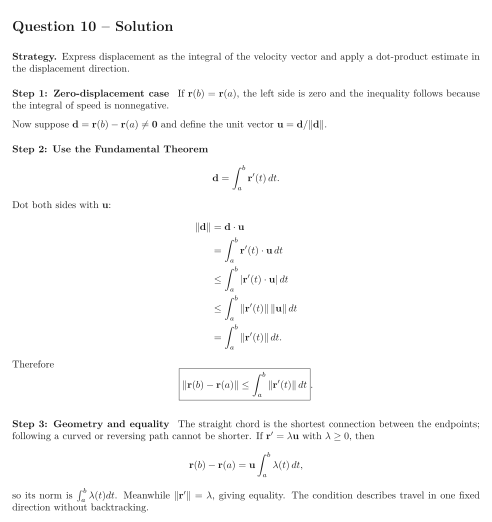
Original worksheet page 2: question and worked solution for 1-9-010

Original worksheet layout. Use Enlarge or open the PDF for a closer view.