Arc Length with Vector Functions — Question 6

PDF ↗

Question 6

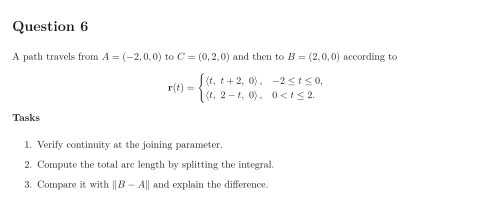
A path travels from A=(−2,0,0)A=(-2,0,0) to C=(0,2,0)C=(0,2,0) and then to B=(2,0,0)B=(2,0,0) according to 𝒓(t)={⟨t,t+2,0⟩,−2≤t≤0,⟨t,2−t,0⟩,0<t≤2.\mathbf r(t)= \begin{cases} \left\langle t,\ t+2,\ 0\right\rangle,&-2\le t\le 0,\\ \left\langle t,\ 2-t,\ 0\right\rangle,&0<t\le 2. \end{cases} Tasks

  1. Verify continuity at the joining parameter.

  2. Compute the total arc length by splitting the integral.

  3. Compare it with ∥B−A∥\|B-A\| and explain the difference.

Original worksheet page 1: question and worked solution for 1-9-006
Show solutionHide solution

Question 6 – Solution

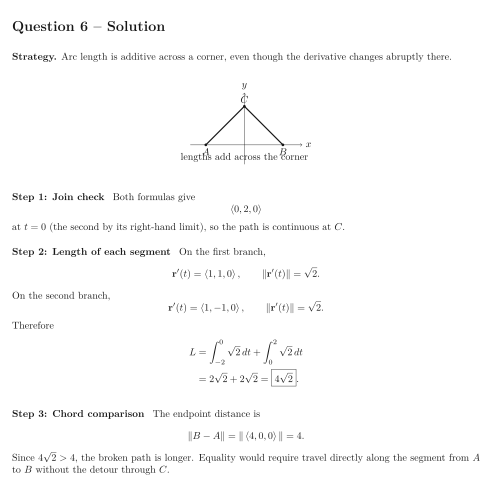
Strategy. Arc length is additive across a corner, even though the derivative changes abruptly there.

See the diagram in the original worksheet below.

Step 1: Join check Both formulas give ⟨0,2,0⟩\left\langle 0,2,0\right\rangle at t=0t=0 (the second by its right-hand limit), so the path is continuous at CC.

Step 2: Length of each segment On the first branch, 𝒓′(t)=⟨1,1,0⟩,∥𝒓′(t)∥=2.\mathbf r'(t)=\left\langle 1,1,0\right\rangle,\qquad \|\mathbf r'(t)\|=\sqrt 2. On the second branch, 𝒓′(t)=⟨1,−1,0⟩,∥𝒓′(t)∥=2.\mathbf r'(t)=\left\langle 1,-1,0\right\rangle,\qquad \|\mathbf r'(t)\|=\sqrt 2. Therefore L=∫−202dt+∫022dt=22+22=42.\begin{align*} L&=\int_{-2}^{0}\sqrt 2\,dt+\int_0^2\sqrt 2\,dt\\ &=2\sqrt 2+2\sqrt 2=\boxed{4\sqrt 2}. \end{align*}

Step 3: Chord comparison The endpoint distance is ∥B−A∥=∥⟨4,0,0⟩∥=4.\|B-A\|=\|\left\langle 4,0,0\right\rangle\|=4. Since 42>44\sqrt 2>4, the broken path is longer. Equality would require travel directly along the segment from AA to BB without the detour through CC.

Original worksheet page 2: question and worked solution for 1-9-006

Original worksheet layout. Use Enlarge or open the PDF for a closer view.