Calculus with Vector Functions β€” Question 9

PDF β†—

Question 9

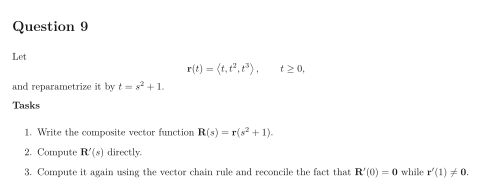
Let 𝒓(t)=⟨t,t2,t3⟩,tβ‰₯0,\mathbf r(t)=\left\langle t,t^2,t^3\right\rangle,\qquad t\ge 0, and reparametrize it by t=s2+1t=s^2+1.

Tasks

  1. Write the composite vector function 𝑹(s)=𝒓(s2+1)\mathbf R(s)=\mathbf r(s^2+1).

  2. Compute 𝑹′(s)\mathbf R'(s) directly.

  3. Compute it again using the vector chain rule and reconcile the fact that 𝑹′(0)=𝟎\mathbf R'(0)=\mathbf 0 while 𝒓′(1)β‰ πŸŽ\mathbf r'(1)\ne\mathbf 0.

Original worksheet page 1: question and worked solution for 1-7-009
Show solutionHide solution

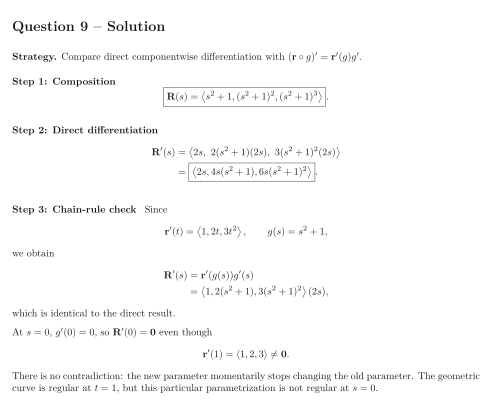
Question 9 – Solution

Strategy. Compare direct componentwise differentiation with (π’“βˆ˜g)β€²=𝒓′(g)gβ€²(\mathbf r\circ g)'=\mathbf r'(g)g'.

Step 1: Composition 𝑹(s)=⟨s2+1,(s2+1)2,(s2+1)3⟩.\boxed{\mathbf R(s)=\left\langle s^2+1,(s^2+1)^2,(s^2+1)^3\right\rangle}.

Step 2: Direct differentiation 𝑹′(s)=⟨2s,2(s2+1)(2s),3(s2+1)2(2s)⟩=⟨2s,4s(s2+1),6s(s2+1)2⟩.\begin{align*} \mathbf R'(s) &=\left\langle 2s,\ 2(s^2+1)(2s),\ 3(s^2+1)^2(2s)\right\rangle\\ &=\boxed{\left\langle 2s,4s(s^2+1),6s(s^2+1)^2\right\rangle}. \end{align*}

Step 3: Chain-rule check Since 𝒓′(t)=⟨1,2t,3t2⟩,g(s)=s2+1,\mathbf r'(t)=\left\langle 1,2t,3t^2\right\rangle,\qquad g(s)=s^2+1, we obtain 𝑹′(s)=𝒓′(g(s))gβ€²(s)=⟨1,2(s2+1),3(s2+1)2⟩(2s),\begin{align*} \mathbf R'(s)&=\mathbf r'(g(s))g'(s)\\ &=\left\langle 1,2(s^2+1),3(s^2+1)^2\right\rangle(2s), \end{align*} which is identical to the direct result.

At s=0s=0, gβ€²(0)=0g'(0)=0, so 𝑹′(0)=𝟎\mathbf R'(0)=\mathbf 0 even though 𝒓′(1)=⟨1,2,3βŸ©β‰ πŸŽ.\mathbf r'(1)=\left\langle 1,2,3\right\rangle\ne\mathbf 0. There is no contradiction: the new parameter momentarily stops changing the old parameter. The geometric curve is regular at t=1t=1, but this particular parametrization is not regular at s=0s=0.

Original worksheet page 2: question and worked solution for 1-7-009

Original worksheet layout. Use Enlarge or open the PDF for a closer view.