Calculus with Vector Functions β€” Question 7

PDF β†—

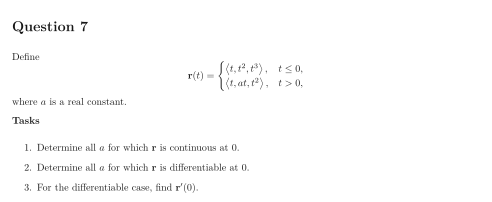
Question 7

Define 𝒓(t)={⟨t,t2,t3⟩,t≀0,⟨t,at,t2⟩,t>0,\mathbf r(t)= \begin{cases} \left\langle t,t^2,t^3\right\rangle,&t\le 0,\\ \left\langle t,at,t^2\right\rangle,&t>0, \end{cases} where aa is a real constant.

Tasks

  1. Determine all aa for which 𝒓\mathbf r is continuous at 00.

  2. Determine all aa for which 𝒓\mathbf r is differentiable at 00.

  3. For the differentiable case, find 𝒓′(0)\mathbf r'(0).

Original worksheet page 1: question and worked solution for 1-7-007
Show solutionHide solution

Question 7 – Solution

Strategy. Continuity compares one-sided function values; differentiability compares one-sided vector difference quotients.

Step 1: Continuity The defined value from the first branch is 𝒓(0)=⟨0,0,0⟩.\mathbf r(0)=\left\langle 0,0,0\right\rangle. From the left, ⟨t,t2,t3βŸ©β†’βŸ¨0,0,0⟩\left\langle t,t^2,t^3\right\rangle\to\left\langle 0,0,0\right\rangle. From the right, ⟨t,at,t2βŸ©β†’βŸ¨0,0,0⟩\left\langle t,at,t^2\right\rangle\to\left\langle 0,0,0\right\rangle for every fixed real aa. Therefore 𝒓\mathbf r is continuous at 00 for every real value of aa.

Step 2: Left derivative As hh approaches zero through negative values, 𝒓(h)βˆ’π’“(0)h=⟨1,h,h2βŸ©β†’βŸ¨1,0,0⟩.\frac{\mathbf r(h)-\mathbf r(0)}h =\left\langle 1,h,h^2\right\rangle\longrightarrow\left\langle 1,0,0\right\rangle.

Step 3: Right derivative As hh approaches zero through positive values, 𝒓(h)βˆ’π’“(0)h=⟨1,a,hβŸ©β†’βŸ¨1,a,0⟩.\frac{\mathbf r(h)-\mathbf r(0)}h =\left\langle 1,a,h\right\rangle\longrightarrow\left\langle 1,a,0\right\rangle. The one-sided derivatives agree exactly when a=0a=0. Hence a=0,𝒓′(0)=⟨1,0,0⟩.\boxed{a=0},\qquad \boxed{\mathbf r'(0)=\left\langle 1,0,0\right\rangle}. This also shows explicitly why continuity alone does not guarantee differentiability.
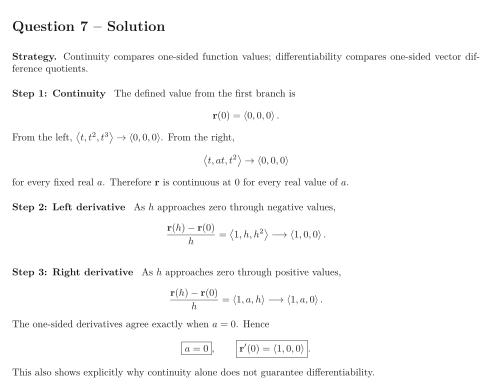
Original worksheet page 2: question and worked solution for 1-7-007

Original worksheet layout. Use Enlarge or open the PDF for a closer view.