Calculus with Vector Functions β€” Question 4

PDF β†—

Question 4

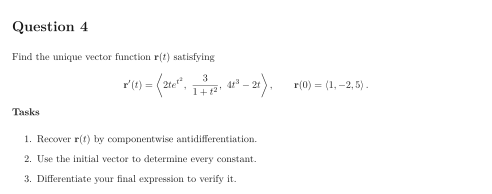
Find the unique vector function 𝒓(t)\mathbf r(t) satisfying 𝒓′(t)=⟨2tet2,31+t2,4t3βˆ’2t⟩,𝒓(0)=⟨1,βˆ’2,5⟩.\mathbf r'(t)=\left\langle 2te^{t^2},\ \frac{3}{1+t^2},\ 4t^3-2t\right\rangle, \qquad \mathbf r(0)=\left\langle 1,-2,5\right\rangle. Tasks

  1. Recover 𝒓(t)\mathbf r(t) by componentwise antidifferentiation.

  2. Use the initial vector to determine every constant.

  3. Differentiate your final expression to verify it.
Original worksheet page 1: question and worked solution for 1-7-004
Show solutionHide solution

Question 4 – Solution

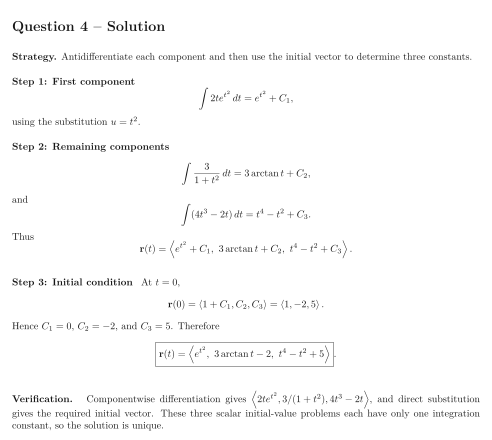
Strategy. Antidifferentiate each component and then use the initial vector to determine three constants.

Step 1: First component ∫2tet2dt=et2+C1,\int 2te^{t^2}\,dt=e^{t^2}+C_1, using the substitution u=t2u=t^2.

Step 2: Remaining components ∫31+t2dt=3arctan⁡t+C2,\int\frac 3{1+t^2}\,dt=3\arctan t+C_2, and ∫(4t3βˆ’2t)dt=t4βˆ’t2+C3.\int(4t^3-2t)\,dt=t^4-t^2+C_3. Thus 𝒓(t)=⟨et2+C1,3arctant+C2,t4βˆ’t2+C3⟩.\mathbf r(t)=\left\langle e^{t^2}+C_1,\ 3\arctan t+C_2,\ t^4-t^2+C_3\right\rangle.

Step 3: Initial condition At t=0t=0, 𝒓(0)=⟨1+C1,C2,C3⟩=⟨1,βˆ’2,5⟩.\mathbf r(0)=\left\langle 1+C_1,C_2,C_3\right\rangle=\left\langle 1,-2,5\right\rangle. Hence C1=0C_1=0, C2=βˆ’2C_2=-2, and C3=5C_3=5. Therefore 𝒓(t)=⟨et2,3arctantβˆ’2,t4βˆ’t2+5⟩.\boxed{\mathbf r(t)=\left\langle e^{t^2},\ 3\arctan t-2,\ t^4-t^2+5\right\rangle}.

Verification. Componentwise differentiation gives ⟨2tet2,3/(1+t2),4t3βˆ’2t⟩\left\langle 2te^{t^2},3/(1+t^2),4t^3-2t\right\rangle, and direct substitution gives the required initial vector. These three scalar initial-value problems each have only one integration constant, so the solution is unique.
Original worksheet page 2: question and worked solution for 1-7-004

Original worksheet layout. Use Enlarge or open the PDF for a closer view.