Vector Functions — Question 10

PDF ↗

Question 10

Consider the closed space curve 𝒓(t)=⟨2cost,2sint,sintcost⟩,0≤t<2π.\mathbf r(t)=\left\langle 2\cos t,\ 2\sin t,\ \sin t\cos t\right\rangle, \qquad 0\le t<2\pi. Tasks

  1. Find two surfaces whose intersection contains the entire trace.

  2. Determine all points where the trace meets the plane z=0z=0.

  3. Prove that the parametrization traces each point exactly once, despite the repeated values of the zz-component.

Original worksheet page 1: question and worked solution for 1-6-010
Show solutionHide solution

Question 10 – Solution

Strategy. Eliminate the parameter using the first two components. For uniqueness, retain the ordered pair (cos⁡t,sin⁡t)(\cos t,\sin t) rather than examining zz alone.

See the diagram in the original worksheet below.

Step 1: Eliminate the parameter The first two components give x2+y2=4(cos⁡2t+sin⁡2t)=4.x^2+y^2=4(\cos^2t+\sin^2t)=4. Also, xy=(2cos⁡t)(2sin⁡t)=4sin⁡tcos⁡t=4z,xy=(2\cos t)(2\sin t)=4\sin t\cos t=4z, so z=xy/4z=xy/4. The trace is therefore contained in x2+y2=4,z=xy4.\boxed{x^2+y^2=4,\qquad z=\frac{xy}{4}}. Conversely, every point of this intersection has (x/2,y/2)(x/2,y/2) on the unit circle and hence equals (cos⁡t,sin⁡t)(\cos t,\sin t) for some tt; thus these equations describe the full trace.

Step 2: Intersections with z=0z=0 Since z=xy/4z=xy/4, we need x=0x=0 or y=0y=0. On x2+y2=4x^2+y^2=4, this yields (2,0,0),(−2,0,0),(0,2,0),(0,−2,0).\boxed{(2,0,0),\ (-2,0,0),\ (0,2,0),\ (0,-2,0)}.

Step 3: One-to-one traversal If 𝒓(t1)=𝒓(t2)\mathbf r(t_1)=\mathbf r(t_2), then the first two coordinates imply (cos⁡t1,sin⁡t1)=(cos⁡t2,sin⁡t2).(\cos t_1,\sin t_1)=(\cos t_2,\sin t_2). Thus t1−t2=2πkt_1-t_2=2\pi k for an integer kk. Inside [0,2π)[0,2\pi), only k=0k=0 is possible, so t1=t2t_1=t_2. Hence no point is repeated.

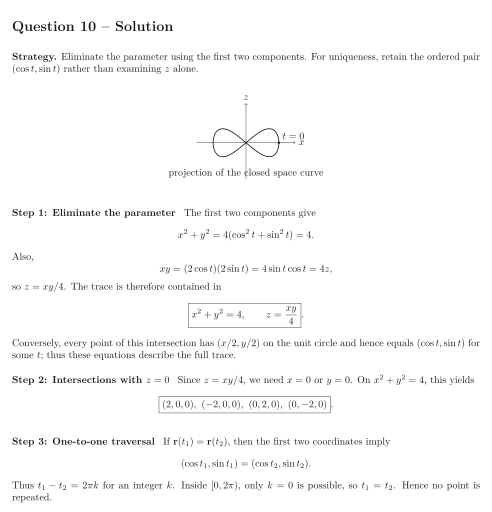
Original worksheet page 2: question and worked solution for 1-6-010

Original worksheet layout. Use Enlarge or open the PDF for a closer view.