Quadric Surfaces — Question 8

PDF ↗

Question 8

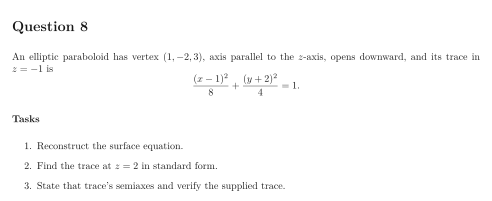
An elliptic paraboloid has vertex (1,−2,3)(1,-2,3), axis parallel to the zz-axis, opens downward, and its trace in z=−1z=-1 is (x−1)28+(y+2)24=1.\frac{(x-1)^2}{8}+\frac{(y+2)^2}{4}=1.

Tasks

  1. Reconstruct the surface equation.

  2. Find the trace at z=2z=2 in standard form.

  3. State that trace’s semiaxes and verify the supplied trace.
Original worksheet page 1: question and worked solution for 1-4-008
Show solutionHide solution

Question 8 – Solution

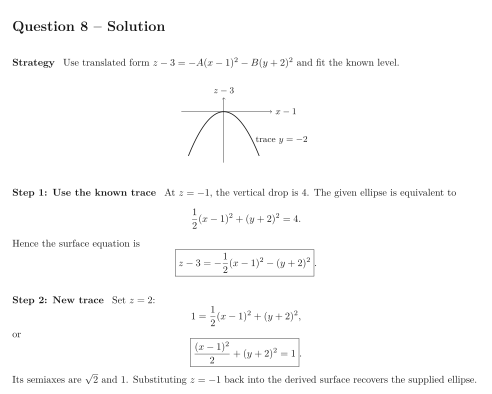
Strategy Use translated form z−3=−A(x−1)2−B(y+2)2z-3=-A(x-1)^2-B(y+2)^2 and fit the known level.

See the diagram in the original worksheet below.

Step 1: Use the known trace At z=−1z=-1, the vertical drop is 44. The given ellipse is equivalent to 12(x−1)2+(y+2)2=4.\frac 12(x-1)^2+(y+2)^2=4. Hence the surface equation is z−3=−12(x−1)2−(y+2)2.\boxed{z-3=-\frac 12(x-1)^2-(y+2)^2}.

Step 2: New trace Set z=2z=2: 1=12(x−1)2+(y+2)2,1=\frac 12(x-1)^2+(y+2)^2, or (x−1)22+(y+2)2=1.\boxed{\frac{(x-1)^2}{2}+(y+2)^2=1}. Its semiaxes are 2\sqrt 2 and 11. Substituting z=−1z=-1 back into the derived surface recovers the supplied ellipse.
Original worksheet page 2: question and worked solution for 1-4-008

Original worksheet layout. Use Enlarge or open the PDF for a closer view.