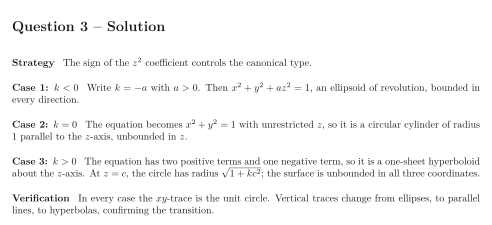
Question 3
For real , classify
Tasks
Classify the surface for , , and .
Describe boundedness in each case.
Compare horizontal and vertical traces across the transition.
Show solutionHide solution
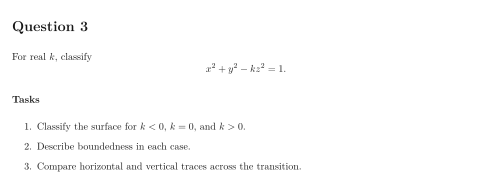
Question 3 – Solution
Strategy The sign of the coefficient controls the canonical type.
Case 1: Write with . Then , an ellipsoid of revolution, bounded in every direction.
Case 2: The equation becomes with unrestricted , so it is a circular cylinder of radius parallel to the -axis, unbounded in .
Case 3: The equation has two positive terms and one negative term, so it is a one-sheet hyperboloid about the -axis. At , the circle has radius ; the surface is unbounded in all three coordinates.
Verification In every case the -trace is the unit circle. Vertical traces change from ellipses, to parallel lines, to hyperbolas, confirming the transition.