Question 9
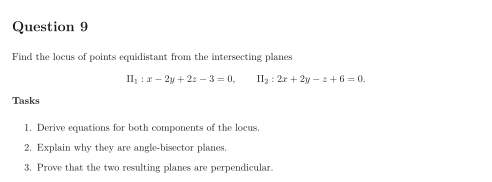
Find the locus of points equidistant from the intersecting planes Tasks
Derive equations for both components of the locus.
Explain why they are angle-bisector planes.
Prove that the two resulting planes are perpendicular.
Show solutionHide solution
Question 9 – Solution
Strategy Use the point-to-plane distance formula with absolute values. Equal normal lengths simplify the two sign cases.
See the diagram in the original worksheet below.
Step 1: Distance equation The normal lengths are Thus equality of point-to-plane distances becomes
Step 2: Resolve the absolute values Let the two expressions be and . The equation gives two cases.
If , then If , then Therefore the locus consists of
Interpretation On either plane, the signed perpendicular displacements from and have equal magnitude. These are precisely the internal and external angle-bisector planes, and both contain the original planes’ intersection line.
Perpendicularity Normals may be chosen as and . Their dot product is , so the bisector planes are perpendicular.
Verification Substituting any point from either boxed plane into the absolute-value equation recovers equal distances.
