Equations of Planes — Question 7

PDF ↗

Question 7

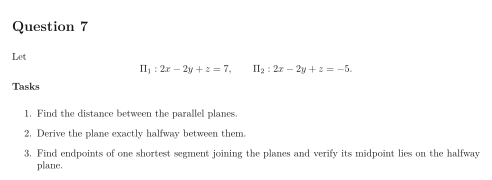
Let Π1:2x−2y+z=7,Π2:2x−2y+z=−5.\Pi_1:2x-2y+z=7,\qquad \Pi_2:2x-2y+z=-5. Tasks

  1. Find the distance between the parallel planes.

  2. Derive the plane exactly halfway between them.

  3. Find endpoints of one shortest segment joining the planes and verify its midpoint lies on the halfway plane.
Original worksheet page 1: question and worked solution for 1-3-007
Show solutionHide solution

Question 7 – Solution

Strategy Put the equations over the same normal. Their constant difference divided by the normal length is the separation.

See the diagram in the original worksheet below.

Step 1: Distance Both planes have normal n→=⟨2,−2,1⟩\vec n=\left\langle 2,-2,1\right\rangle, whose length is ∥n→∥=22+(−2)2+12=3.\|\vec n\|=\sqrt{2^2+(-2)^2+1^2}=3. Because their left sides are identical, the distance is the absolute difference of constants divided by ∥n→∥\|\vec n\|: d(Π1,Π2)=|7−(−5)|3=4.\boxed{d(\Pi_1,\Pi_2)=\frac{|7-(-5)|}{3}=4}.

Step 2: Halfway plane A parallel plane has form 2x−2y+z=c2x-2y+z=c. Equal distance from cc to 77 and −5-5 requires 7−c=c−(−5)⇒2c=2⇒c=1.7-c=c-(-5)\Longrightarrow 2c=2\Longrightarrow c=1. Thus 2x−2y+z=1.\boxed{2x-2y+z=1}.

Step 3: Shortest connector Choose A=(3,0,1)A=(3,0,1); indeed 2(3)−2(0)+1=72(3)-2(0)+1=7. The unit normal is n→/3\vec n/3, so moving four units toward Π2\Pi_2 gives B=A−43⟨2,−2,1⟩=(13,83,−13),B=A-\frac 43\left\langle 2,-2,1\right\rangle=\boxed{\left(\tfrac 13,\tfrac 83,-\tfrac 13\right)}, Substitution gives 2(1/3)−2(8/3)−1/3=−52(1/3)-2(8/3)-1/3=-5, so B∈Π2B\in\Pi_2. Its midpoint with AA is M=(53,43,13).\boxed{M=\left(\tfrac 53,\tfrac 43,\tfrac 13\right)}.

Verification 2(5/3)−2(4/3)+1/3=12(5/3)-2(4/3)+1/3=1. Also B−AB-A is parallel to the common normal, so ABAB is perpendicular to both planes and is therefore a shortest connector.

Original worksheet page 2: question and worked solution for 1-3-007

Original worksheet layout. Use Enlarge or open the PDF for a closer view.