Question 10
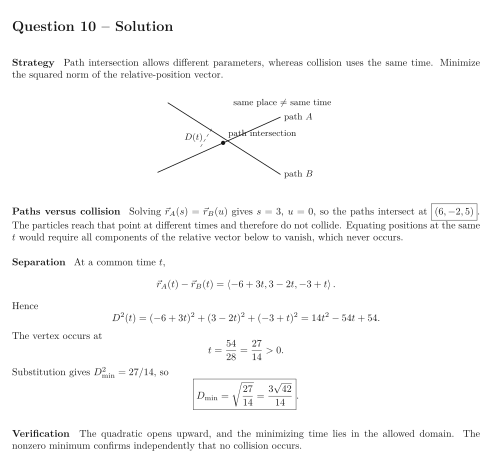
Two particles move for according to
Tasks
Determine whether their geometric paths intersect.
Determine whether the particles collide.
Find the time and value of their minimum separation for .
Show solutionHide solution
Question 10 – Solution
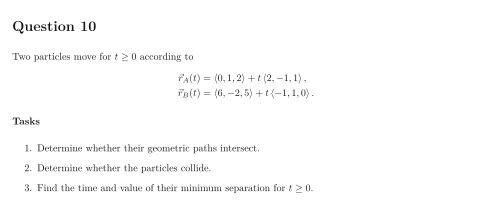
Strategy Path intersection allows different parameters, whereas collision uses the same time. Minimize the squared norm of the relative-position vector.
See the diagram in the original worksheet below.
Paths versus collision Solving gives , , so the paths intersect at . The particles reach that point at different times and therefore do not collide. Equating positions at the same would require all components of the relative vector below to vanish, which never occurs.
Separation At a common time , Hence The vertex occurs at Substitution gives , so
Verification The quadratic opens upward, and the minimizing time lies in the allowed domain. The nonzero minimum confirms independently that no collision occurs.