Question 5
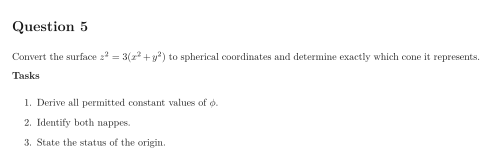
Convert the surface to spherical coordinates and determine exactly which cone it represents.
Tasks
Derive all permitted constant values of .
Identify both nappes.
State the status of the origin.
Show solutionHide solution
Question 5 – Solution
Strategy. Substitute and , treating separately.
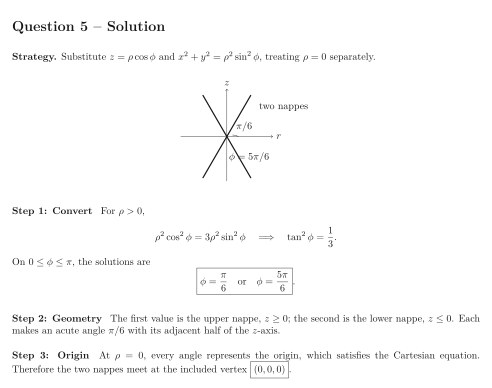
See the diagram in the original worksheet below.
Step 1: Convert For , On , the solutions are
Step 2: Geometry The first value is the upper nappe, ; the second is the lower nappe, . Each makes an acute angle with its adjacent half of the -axis.
Step 3: Origin At , every angle represents the origin, which satisfies the Cartesian equation. Therefore the two nappes meet at the included vertex .