Spherical Coordinates — Question 1

PDF ↗

Question 1

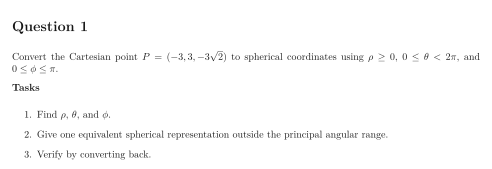
Convert the Cartesian point P=(−3,3,−32)P=(-3,3,-3\sqrt 2) to spherical coordinates using ρ≥0\rho\ge 0, 0≤θ<2π0\le\theta<2\pi, and 0≤ϕ≤π0\le\phi\le\pi.

Tasks

  1. Find ρ\rho, θ\theta, and ϕ\phi.

  2. Give one equivalent spherical representation outside the principal angular range.

  3. Verify by converting back.

Original worksheet page 1: question and worked solution for 1-13-001
Show solutionHide solution

Question 1 – Solution

Strategy. Find radial distance first, use the quadrant of (x,y)(x,y) for θ\theta, and use cos⁡ϕ=z/ρ\cos\phi=z/\rho.

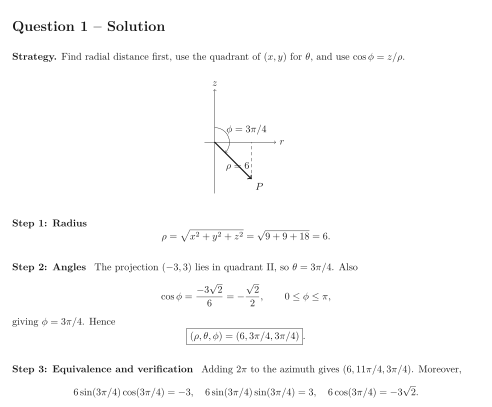
See the diagram in the original worksheet below.

Step 1: Radius ρ=x2+y2+z2=9+9+18=6.\rho=\sqrt{x^2+y^2+z^2}=\sqrt{9+9+18}=6.

Step 2: Angles The projection (−3,3)(-3,3) lies in quadrant II, so θ=3π/4\theta=3\pi/4. Also cos⁡ϕ=−326=−22,0≤ϕ≤π,\cos\phi=\frac{-3\sqrt 2}{6}=-\frac{\sqrt 2}{2},\qquad 0\le\phi\le\pi, giving ϕ=3π/4\phi=3\pi/4. Hence (ρ,θ,ϕ)=(6,3π/4,3π/4).\boxed{(\rho,\theta,\phi)=(6,3\pi/4,3\pi/4)}.

Step 3: Equivalence and verification Adding 2π2\pi to the azimuth gives (6,11π/4,3π/4)(6,11\pi/4,3\pi/4). Moreover, 6sin⁡(3π/4)cos⁡(3π/4)=−3,6sin⁡(3π/4)sin⁡(3π/4)=3,6cos⁡(3π/4)=−32.6\sin(3\pi/4)\cos(3\pi/4)=-3,\quad 6\sin(3\pi/4)\sin(3\pi/4)=3,\quad 6\cos(3\pi/4)=-3\sqrt 2.

Original worksheet page 2: question and worked solution for 1-13-001

Original worksheet layout. Use Enlarge or open the PDF for a closer view.