Velocity and Acceleration β€” Question 6

PDF β†—

Question 6

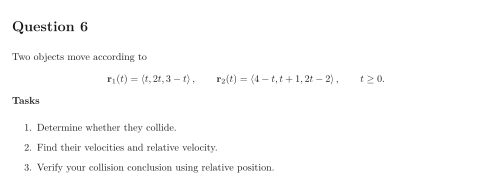
Two objects move according to 𝒓1(t)=⟨t,2t,3βˆ’t⟩,𝒓2(t)=⟨4βˆ’t,t+1,2tβˆ’2⟩,tβ‰₯0.\mathbf r_1(t)=\left\langle t,2t,3-t\right\rangle,\qquad \mathbf r_2(t)=\left\langle 4-t,t+1,2t-2\right\rangle,\qquad t\ge 0. Tasks

  1. Determine whether they collide.

  2. Find their velocities and relative velocity.

  3. Verify your collision conclusion using relative position.
Original worksheet page 1: question and worked solution for 1-11-006
Show solutionHide solution

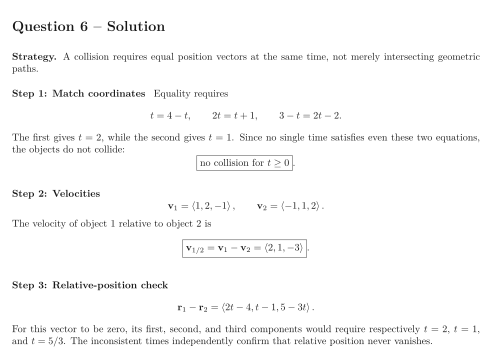
Question 6 – Solution

Strategy. A collision requires equal position vectors at the same time, not merely intersecting geometric paths.

Step 1: Match coordinates Equality requires t=4βˆ’t,2t=t+1,3βˆ’t=2tβˆ’2.t=4-t,\qquad 2t=t+1,\qquad 3-t=2t-2. The first gives t=2t=2, while the second gives t=1t=1. Since no single time satisfies even these two equations, the objects do not collide: no collision for tβ‰₯0.\boxed{\text{no collision for }t\ge 0}.

Step 2: Velocities 𝒗1=⟨1,2,βˆ’1⟩,𝒗2=βŸ¨βˆ’1,1,2⟩.\mathbf v_1=\left\langle 1,2,-1\right\rangle,\qquad \mathbf v_2=\left\langle -1,1,2\right\rangle. The velocity of object 1 relative to object 2 is 𝒗1/2=𝒗1βˆ’π’—2=⟨2,1,βˆ’3⟩.\boxed{\mathbf v_{1/2}=\mathbf v_1-\mathbf v_2=\left\langle 2,1,-3\right\rangle}.

Step 3: Relative-position check 𝒓1βˆ’π’“2=⟨2tβˆ’4,tβˆ’1,5βˆ’3t⟩.\mathbf r_1-\mathbf r_2 =\left\langle 2t-4,t-1,5-3t\right\rangle. For this vector to be zero, its first, second, and third components would require respectively t=2t=2, t=1t=1, and t=5/3t=5/3. The inconsistent times independently confirm that relative position never vanishes.
Original worksheet page 2: question and worked solution for 1-11-006

Original worksheet layout. Use Enlarge or open the PDF for a closer view.