Velocity and Acceleration β€” Question 4

PDF β†—

Question 4

A particle moves on a circle according to 𝒓(t)=⟨Rcos(Ο‰t),Rsin(Ο‰t),0⟩,R>0,Ο‰>0.\mathbf r(t)=\left\langle R\cos(\omega t),R\sin(\omega t),0\right\rangle, \qquad R>0,\ \omega>0. Tasks

  1. Find velocity, speed, and acceleration.

  2. Prove velocity is perpendicular to acceleration.

  3. Express acceleration in terms of position and identify its magnitude.
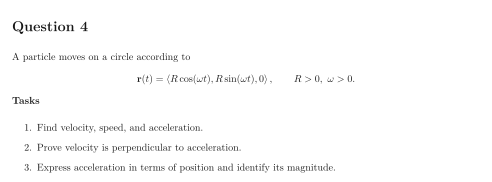
Original worksheet page 1: question and worked solution for 1-11-004
Show solutionHide solution

Question 4 – Solution

Strategy. Differentiate symbolically and use trigonometric identities and dot products.

See the diagram in the original worksheet below.

Step 1: Differentiate 𝒗=βŸ¨βˆ’RΟ‰sin(Ο‰t),RΟ‰cos(Ο‰t),0⟩,\mathbf v=\left\langle -R\omega\sin(\omega t),R\omega\cos(\omega t),0\right\rangle, so βˆ₯𝒗βˆ₯=RΟ‰.\boxed{\|\mathbf v\|=R\omega}. Differentiating again, 𝒂=βŸ¨βˆ’RΟ‰2cos(Ο‰t),βˆ’RΟ‰2sin(Ο‰t),0⟩.\boxed{\mathbf a=\left\langle -R\omega^2\cos(\omega t),-R\omega^2\sin(\omega t),0\right\rangle}.

Step 2: Orthogonality 𝒗⋅𝒂=R2Ο‰3sin⁡(Ο‰t)cos⁡(Ο‰t)βˆ’R2Ο‰3cos⁡(Ο‰t)sin⁡(Ο‰t)=0.\begin{align*} \mathbf v\cdot\mathbf a &=R^2\omega^3\sin(\omega t)\cos(\omega t) -R^2\omega^3\cos(\omega t)\sin(\omega t)=0. \end{align*} Thus π’—βŸ‚π’‚\boxed{\mathbf v\perp\mathbf a}.

Step 3: Inward acceleration Comparing with 𝒓\mathbf r gives 𝒂(t)=βˆ’Ο‰2𝒓(t).\boxed{\mathbf a(t)=-\omega^2\mathbf r(t)}. It points toward the origin, and βˆ₯𝒂βˆ₯=RΟ‰2=(RΟ‰)2R=v2R.\boxed{\|\mathbf a\|=R\omega^2=\frac{(R\omega)^2}{R}=\frac{v^2}{R}}. This is purely normal acceleration; the constant speed confirms there is no tangential component.
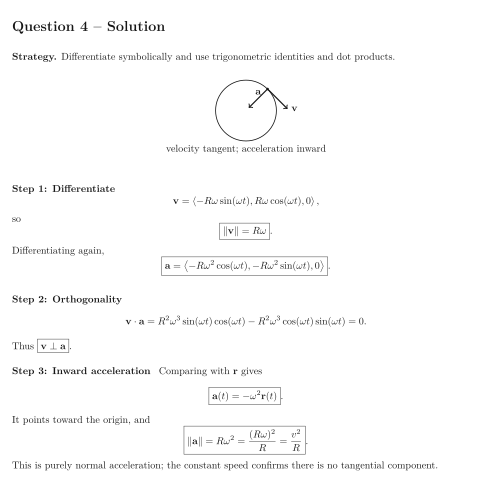
Original worksheet page 2: question and worked solution for 1-11-004

Original worksheet layout. Use Enlarge or open the PDF for a closer view.