Velocity and Acceleration β€” Question 1

PDF β†—

Question 1

A particle has position 𝒓(t)=⟨t2βˆ’2t,t3βˆ’3t,4t+1⟩,tβ‰₯0.\mathbf r(t)=\left\langle t^2-2t,\ t^3-3t,\ 4t+1\right\rangle,\qquad t\ge 0. Tasks

  1. Find velocity, acceleration, and speed.

  2. Evaluate them at t=1t=1.

  3. Find the tangent line to the trajectory at that time.
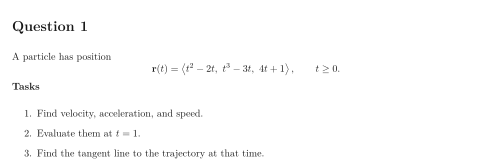
Original worksheet page 1: question and worked solution for 1-11-001
Show solutionHide solution

Question 1 – Solution

Strategy. Differentiate position componentwise; speed is the magnitude of velocity.

Step 1: Velocity and acceleration 𝒗(t)=𝒓′(t)=⟨2tβˆ’2,3t2βˆ’3,4⟩,\mathbf v(t)=\mathbf r'(t)=\left\langle 2t-2,3t^2-3,4\right\rangle, and 𝒂(t)=𝒗′(t)=⟨2,6t,0⟩.\mathbf a(t)=\mathbf v'(t)=\left\langle 2,6t,0\right\rangle. Therefore speed=βˆ₯𝒗(t)βˆ₯=(2tβˆ’2)2+(3t2βˆ’3)2+16.\boxed{\text{speed}=\|\mathbf v(t)\| =\sqrt{(2t-2)^2+(3t^2-3)^2+16}}.

Step 2: Values at t=1t=1 𝒓(1)=βŸ¨βˆ’1,βˆ’2,5⟩,𝒗(1)=⟨0,0,4⟩,𝒂(1)=⟨2,6,0⟩.\mathbf r(1)=\left\langle -1,-2,5\right\rangle,\quad \boxed{\mathbf v(1)=\left\langle 0,0,4\right\rangle},\quad \boxed{\mathbf a(1)=\left\langle 2,6,0\right\rangle}. The speed is 4\boxed{4}.

Step 3: Tangent line Since 𝒗(1)β‰ πŸŽ\mathbf v(1)\ne\mathbf 0, it gives the tangent direction: 𝑳(s)=βŸ¨βˆ’1,βˆ’2,5⟩+s⟨0,0,1⟩.\boxed{\mathbf L(s)=\left\langle -1,-2,5\right\rangle+s\left\langle 0,0,1\right\rangle}. The simplified direction is parallel to velocity. At s=0s=0 the line passes through the correct position.
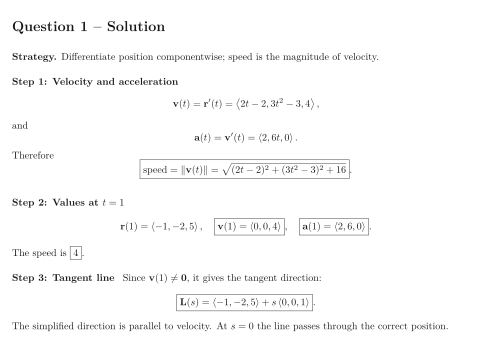
Original worksheet page 2: question and worked solution for 1-11-001

Original worksheet layout. Use Enlarge or open the PDF for a closer view.