Arc Length with Vector Functions — Question 10

PDF ↗

Question 10

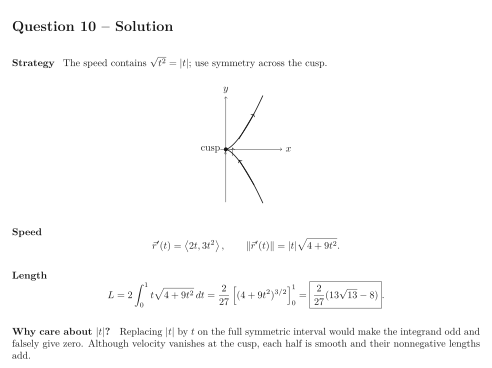
Consider r→(t)=⟨t2,t3⟩\vec r(t)=\left\langle t^2,t^3\right\rangle on −1≤t≤1-1\le t\le 1. The parameterization is not regular at t=0t=0. Determine the total arc length exactly and explain why one must split the integral or preserve an absolute value.

Original worksheet page 1: question and worked solution for 6-9-010
Show solutionHide solution

Question 10 – Solution

Strategy The speed contains t2=|t|\sqrt{t^2}=|t|; use symmetry across the cusp.

See the diagram in the original worksheet below.

Speed r→′(t)=⟨2t,3t2⟩,∥r→′(t)∥=|t|4+9t2.\vec r'(t)=\left\langle 2t,3t^2\right\rangle,\qquad \|\vec r'(t)\|=|t|\sqrt{4+9t^2}.

Length L=2∫01t4+9t2dt=227[(4+9t2)3/2]01=227(1313−8).L=2\int_0^1t\sqrt{4+9t^2}\,dt =\frac{2}{27}\left[(4+9t^2)^{3/2}\right]_0^1 =\boxed{\frac{2}{27}(13\sqrt{13}-8)}.

Why care about |t||t|? Replacing |t||t| by tt on the full symmetric interval would make the integrand odd and falsely give zero. Although velocity vanishes at the cusp, each half is smooth and their nonnegative lengths add.
Original worksheet page 2: question and worked solution for 6-9-010

Original worksheet layout. Use Enlarge or open the PDF for a closer view.