Arc Length with Vector Functions — Question 5

PDF ↗

Question 5

Evaluate exactly the length of r→(t)=⟨et,e−t,2t⟩\vec r(t)=\left\langle e^t,e^{-t},\sqrt 2\,t\right\rangle for 0≤t≤ln⁡20\le t\le\ln 2. The square root in the speed appears complicated; identify its hidden perfect square.

Original worksheet page 1: question and worked solution for 6-9-005
Show solutionHide solution

Question 5 – Solution

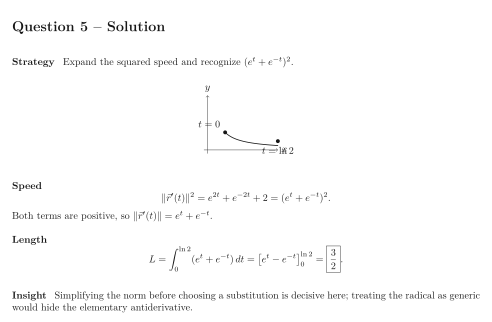
Strategy Expand the squared speed and recognize (et+e−t)2(e^t+e^{-t})^2.

See the diagram in the original worksheet below.

Speed ∥r→′(t)∥2=e2t+e−2t+2=(et+e−t)2.\|\vec r'(t)\|^2=e^{2t}+e^{-2t}+2=(e^t+e^{-t})^2. Both terms are positive, so ∥r→′(t)∥=et+e−t\|\vec r'(t)\|=e^t+e^{-t}.

Length L=∫0ln⁡2(et+e−t)dt=[et−e−t]0ln⁡2=32.L=\int_0^{\ln 2}(e^t+e^{-t})\,dt =\left[e^t-e^{-t}\right]_0^{\ln 2} =\boxed{\frac 32}.

Insight Simplifying the norm before choosing a substitution is decisive here; treating the radical as generic would hide the elementary antiderivative.

Original worksheet page 2: question and worked solution for 6-9-005

Original worksheet layout. Use Enlarge or open the PDF for a closer view.