Arc Length with Vector Functions — Question 1

PDF ↗

Question 1

A particle follows the helix r→(t)=⟨3cost,3sint,4t⟩\vec r(t)=\left\langle 3\cos t,3\sin t,4t\right\rangle for 0≤t≤2π0\le t\le 2\pi. Find the exact distance traveled. Then explain why the vertical rise alone is not the distance.

Original worksheet page 1: question and worked solution for 6-9-001
Show solutionHide solution

Question 1 – Solution

Strategy Distance traveled is the integral of speed, not the net change in any one coordinate.

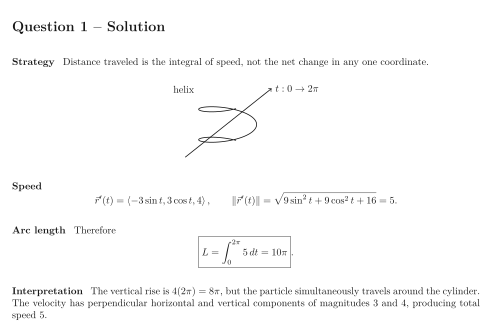
See the diagram in the original worksheet below.

Speed r→′(t)=⟨−3sint,3cost,4⟩,∥r→′(t)∥=9sin⁡2t+9cos⁡2t+16=5.\vec r'(t)=\left\langle -3\sin t,3\cos t,4\right\rangle,\qquad \|\vec r'(t)\|=\sqrt{9\sin^2t+9\cos^2t+16}=5.

Arc length Therefore L=∫02π5dt=10π.\boxed{L=\int_0^{2\pi}5\,dt=10\pi}.

Interpretation The vertical rise is 4(2π)=8π4(2\pi)=8\pi, but the particle simultaneously travels around the cylinder. The velocity has perpendicular horizontal and vertical components of magnitudes 33 and 44, producing total speed 55.

Original worksheet page 2: question and worked solution for 6-9-001

Original worksheet layout. Use Enlarge or open the PDF for a closer view.