Tangent, Normal and Binormal Vectors — Question 10

PDF ↗

Question 10

For the unit circle r→(t)=⟨cost,sint⟩\vec r(t)=\left\langle\cos t,\sin t\right\rangle, define its involute by q→(t)=r→(t)−t𝑻(t)\vec q(t)=\vec r(t)-t\mathbf T(t) for t>0t>0. Find 𝑻q(t)\mathbf T_q(t) and show that it is parallel to the circle’s principal normal at the corresponding point.

Original worksheet page 1: question and worked solution for 6-8-010
Show solutionHide solution

Question 10 – Solution

Strategy Differentiate the involute and use the circle’s simple Frenet derivatives.

See the diagram in the original worksheet below.

Circle frame 𝑻(t)=⟨−sint,cost⟩\mathbf T(t)=\left\langle-\sin t,\cos t\right\rangle and 𝑻′(t)=⟨−cost,−sint⟩=𝑵(t)\mathbf T'(t)=\left\langle-\cos t,-\sin t\right\rangle=\mathbf N(t).

Involute derivative Differentiating, q→′=r→′−𝑻−t𝑻′=𝑻−𝑻−t𝑵=−t𝑵.\vec q'=\vec r'-\mathbf T-t\mathbf T'=\mathbf T-\mathbf T-t\mathbf N=-t\mathbf N. Since t>0t>0, ∥q→′∥=t\|\vec q'\|=t, so 𝑻q=−𝑵=⟨cost,sint⟩\boxed{\mathbf T_q=-\mathbf N=\left\langle\cos t,\sin t\right\rangle}.

Interpretation The taut string leaves the circle tangentially, while the involute’s tangent points along the outward radial direction.
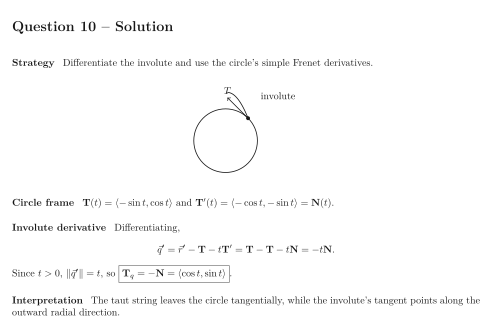
Original worksheet page 2: question and worked solution for 6-8-010

Original worksheet layout. Use Enlarge or open the PDF for a closer view.