Tangent, Normal and Binormal Vectors — Question 2

PDF ↗

Question 2

For the circle r→(t)=⟨acost,asint,h⟩\vec r(t)=\left\langle a\cos t,a\sin t,h\right\rangle with a>0a>0, compute 𝑻,𝑵,𝑩\mathbf T,\mathbf N,\mathbf B. Explain why 𝑵\mathbf N is independent of aa and why 𝑩\mathbf B is constant.

Original worksheet page 1: question and worked solution for 6-8-002
Show solutionHide solution

Question 2 – Solution

Strategy The parameter changes angular position while aa changes only the circle’s scale.

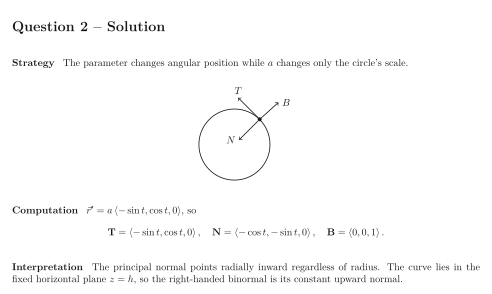
See the diagram in the original worksheet below.

Computation r→′=a⟨−sint,cost,0⟩\vec r'=a\left\langle-\sin t,\cos t,0\right\rangle, so 𝑻=⟨−sint,cost,0⟩,𝑵=⟨−cost,−sint,0⟩,𝑩=⟨0,0,1⟩.\mathbf T=\left\langle-\sin t,\cos t,0\right\rangle,\quad \mathbf N=\left\langle-\cos t,-\sin t,0\right\rangle,\quad \mathbf B=\left\langle 0,0,1\right\rangle.

Interpretation The principal normal points radially inward regardless of radius. The curve lies in the fixed horizontal plane z=hz=h, so the right-handed binormal is its constant upward normal.
Original worksheet page 2: question and worked solution for 6-8-002

Original worksheet layout. Use Enlarge or open the PDF for a closer view.
