Calculus with Vector Functions — Question 4

PDF ↗

Question 4

The curves r→1(t)=⟨t,t2,t3⟩\vec r_1(t)=\left\langle t,t^2,t^3\right\rangle and r→2(s)=⟨s2,s,s3⟩\vec r_2(s)=\left\langle s^2,s,s^3\right\rangle meet at the origin and at (1,1,1)(1,1,1). Find the smaller angle between their tangent lines at each intersection.

Original worksheet page 1: question and worked solution for 6-7-004
Show solutionHide solution

Question 4 – Solution

Strategy Differentiate each parametrization and evaluate using its own parameter at the shared point.

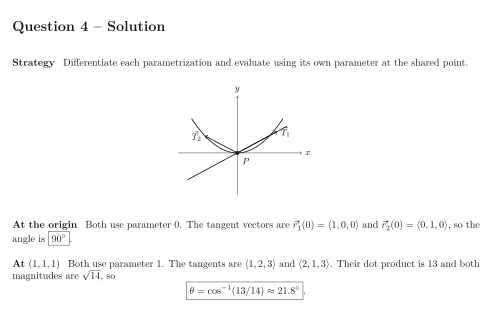
See the diagram in the original worksheet below.

At the origin Both use parameter 0. The tangent vectors are r→1′(0)=⟨1,0,0⟩\vec r_1'(0)=\left\langle 1,0,0\right\rangle and r→2′(0)=⟨0,1,0⟩\vec r_2'(0)=\left\langle 0,1,0\right\rangle, so the angle is 90∘\boxed{90^\circ}.

At (1,1,1)(1,1,1) Both use parameter 1. The tangents are ⟨1,2,3⟩\left\langle 1,2,3\right\rangle and ⟨2,1,3⟩\left\langle 2,1,3\right\rangle. Their dot product is 13 and both magnitudes are 14\sqrt{14}, so θ=cos⁡−1(13/14)≈21.8∘.\boxed{\theta=\cos^{-1}(13/14)\approx 21.8^\circ}.

Original worksheet page 2: question and worked solution for 6-7-004

Original worksheet layout. Use Enlarge or open the PDF for a closer view.