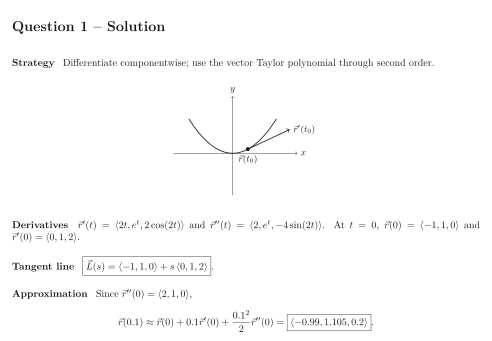
Question 1 For r→(t)=⟨t2−1,et,sin(2t)⟩\vec r(t)=\left\langle t^2-1,e^t,\sin(2t)\right\rangle, find r→′(t)\vec r'(t) and r→″(t)\vec r''(t). Find the tangent line at t=0t=0 and a second-order approximation to r→(0.1)\vec r(0.1). Show solutionHide solution+Question 1 – Solution Strategy Differentiate componentwise; use the vector Taylor polynomial through second order. See the diagram in the original worksheet below. Derivatives r→′(t)=⟨2t,et,2cos(2t)⟩\vec r'(t)=\left\langle 2t,e^t,2\cos(2t)\right\rangle and r→″(t)=⟨2,et,−4sin(2t)⟩\vec r''(t)=\left\langle 2,e^t,-4\sin(2t)\right\rangle. At t=0t=0, r→(0)=⟨−1,1,0⟩\vec r(0)=\left\langle-1,1,0\right\rangle and r→′(0)=⟨0,1,2⟩\vec r'(0)=\left\langle 0,1,2\right\rangle. Tangent line L→(s)=⟨−1,1,0⟩+s⟨0,1,2⟩\boxed{\vec L(s)=\left\langle-1,1,0\right\rangle+s\left\langle 0,1,2\right\rangle}. Approximation Since r→″(0)=⟨2,1,0⟩\vec r''(0)=\left\langle 2,1,0\right\rangle, r→(0.1)≈r→(0)+0.1r→′(0)+0.122r→″(0)=⟨−0.99,1.105,0.2⟩.\vec r(0.1)\approx\vec r(0)+0.1\vec r'(0)+\frac{0.1^2}{2}\vec r''(0)=\boxed{\left\langle-0.99,1.105,0.2\right\rangle}.