Functions of Several Variables — Question 9

PDF ↗

Question 9

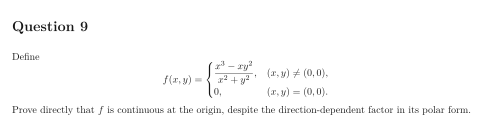
Define f(x,y)={x3−xy2x2+y2,(x,y)≠(0,0),0,(x,y)=(0,0).f(x,y)=\begin{cases}\dfrac{x^3-xy^2}{x^2+y^2},&(x,y)\ne(0,0),\\[4pt]0,&(x,y)=(0,0).\end{cases} Prove directly that ff is continuous at the origin, despite the direction-dependent factor in its polar form.
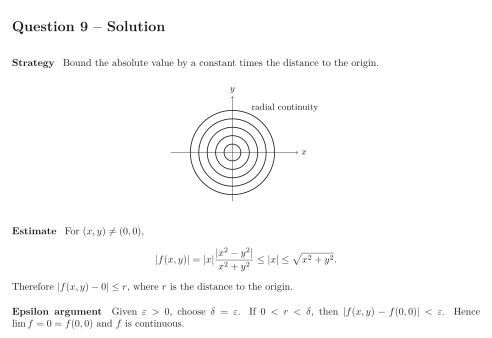
Original worksheet page 1: question and worked solution for 6-5-009
Show solutionHide solution

Question 9 – Solution

Strategy Bound the absolute value by a constant times the distance to the origin.

See the diagram in the original worksheet below.

Estimate For (x,y)≠(0,0)(x,y)\ne(0,0), |f(x,y)|=|x||x2−y2|x2+y2≤|x|≤x2+y2.|f(x,y)|=|x|\frac{|x^2-y^2|}{x^2+y^2}\le |x|\le\sqrt{x^2+y^2}. Therefore |f(x,y)−0|≤r|f(x,y)-0|\le r, where rr is the distance to the origin.

Epsilon argument Given ε>0\varepsilon>0, choose δ=ε\delta=\varepsilon. If 0<r<δ0<r<\delta, then |f(x,y)−f(0,0)|<ε|f(x,y)-f(0,0)|<\varepsilon. Hence lim⁡f=0=f(0,0)\lim f=0=f(0,0) and ff is continuous.

Original worksheet page 2: question and worked solution for 6-5-009

Original worksheet layout. Use Enlarge or open the PDF for a closer view.