Question 10
Derive the distance formula between and using the Pythagorean theorem twice. Then use it to find all values of for which the distance from to is 6.

Show solutionHide solution
Question 10 – Solution
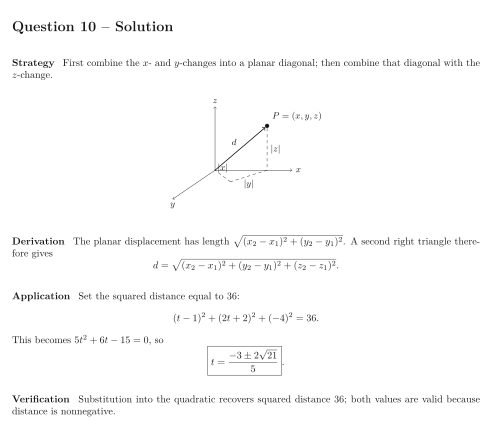
Strategy First combine the - and -changes into a planar diagonal; then combine that diagonal with the -change.
See the diagram in the original worksheet below.
Derivation The planar displacement has length . A second right triangle therefore gives
Application Set the squared distance equal to 36: This becomes , so
Verification Substitution into the quadratic recovers squared distance 36; both values are valid because distance is nonnegative.