Absolute Convergence and Divergence — Question 7
Question 7
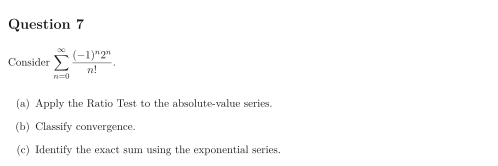
Consider
.
Apply the Ratio Test to the absolute-value series.
Classify convergence.
Identify the exact sum using the exponential series.
Show solutionHide solution+
Question 7 –
Solution
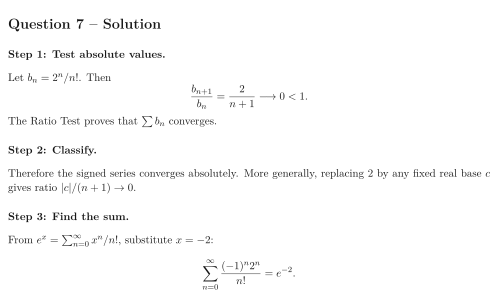
Step 1: Test absolute values.
Let
.
Then
The Ratio Test proves that
converges.
Step 2: Classify.
Therefore the signed series converges absolutely. More generally,
replacing
by any fixed real base
gives ratio
.
Step 3: Find the sum.
From
,
substitute
:
Original worksheet layout. Use Enlarge or open the PDF for a closer view.