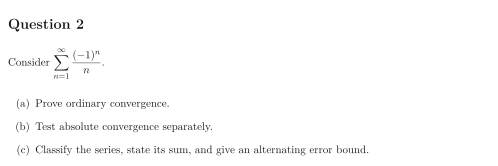
Question 2
Consider .
Prove ordinary convergence.
Test absolute convergence separately.
Classify the series, state its sum, and give an alternating error bound.
Show solutionHide solution
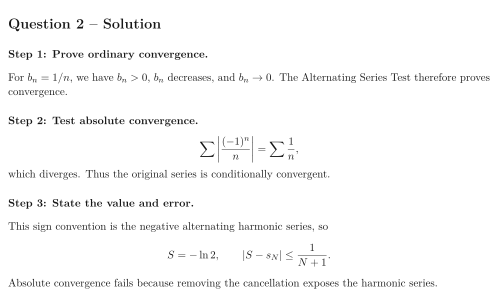
Question 2 – Solution
Step 1: Prove ordinary convergence.
For , we have , decreases, and . The Alternating Series Test therefore proves convergence.
Step 2: Test absolute convergence.
which diverges. Thus the original series is conditionally convergent.
Step 3: State the value and error.
This sign convention is the negative alternating harmonic series, so Absolute convergence fails because removing the cancellation exposes the harmonic series.