Question 7
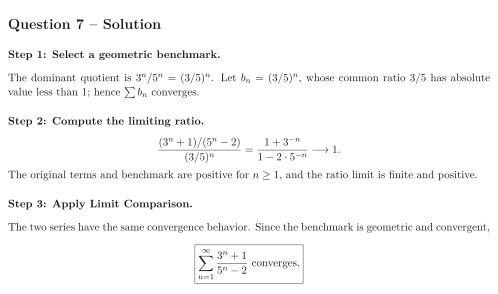
Consider .
Select a geometric benchmark from the dominant exponential terms.
Compute the Limit Comparison Test ratio.
Classify the series and identify the benchmark’s common ratio.
Show solutionHide solution
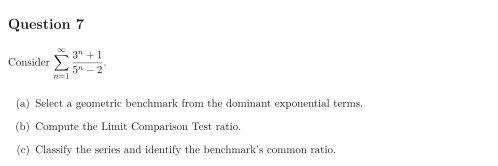
Question 7 – Solution
Step 1: Select a geometric benchmark.
The dominant quotient is . Let , whose common ratio has absolute value less than ; hence converges.
Step 2: Compute the limiting ratio.
The original terms and benchmark are positive for , and the ratio limit is finite and positive.
Step 3: Apply Limit Comparison.
The two series have the same convergence behavior. Since the benchmark is geometric and convergent,