Integral Test — Question 8
Question 8
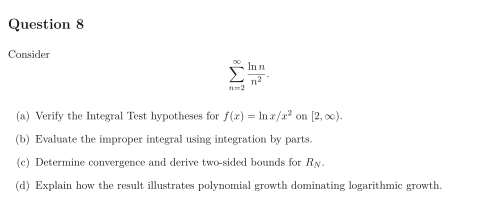
Consider
Verify the Integral Test hypotheses for
on
.
Evaluate the improper integral using integration by
parts.
Determine convergence and derive two-sided bounds for
.
Explain how the result illustrates polynomial growth dominating
logarithmic growth.
Show solutionHide solution+
Question 8 –
Solution
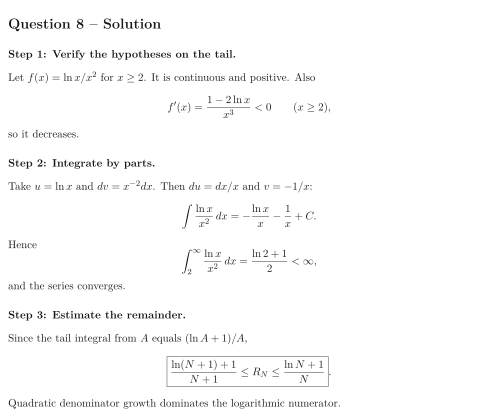
Step 1: Verify the
hypotheses on the tail.
Let
for
.
It is continuous and positive. Also
so it decreases.
Step 2: Integrate by parts.
Take
and
.
Then
and
:
Hence
and the series converges.
Step 3: Estimate the
remainder.
Since the tail integral from
equals
,
Quadratic denominator growth dominates the logarithmic numerator.
Original worksheet layout. Use Enlarge or open the PDF for a closer view.