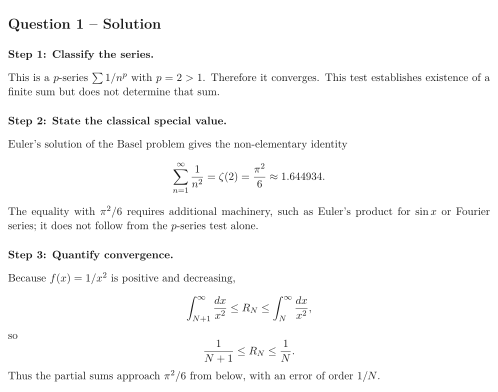
Question 1
Consider the Basel series .
Prove that the series converges using the -series test.
State Euler’s classical evaluation of its exact sum and give a decimal approximation.
Use an integral estimate to bound the remainder after terms, and explain why convergence alone does not produce the exact constant.
Show solutionHide solution
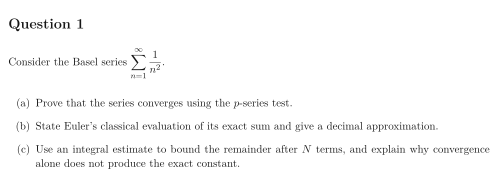
Question 1 – Solution
Step 1: Classify the series.
This is a -series with . Therefore it converges. This test establishes existence of a finite sum but does not determine that sum.
Step 2: State the classical special value.
Euler’s solution of the Basel problem gives the non-elementary identity The equality with requires additional machinery, such as Euler’s product for or Fourier series; it does not follow from the -series test alone.
Step 3: Quantify convergence.
Because is positive and decreasing, so Thus the partial sums approach from below, with an error of order .