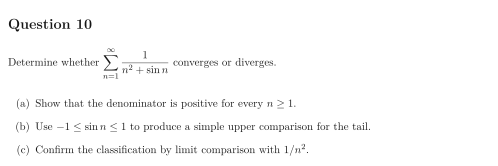
Question 10
Determine whether converges or diverges.
Show that the denominator is positive for every .
Use to produce a simple upper comparison for the tail.
Confirm the classification by limit comparison with .
Show solutionHide solution
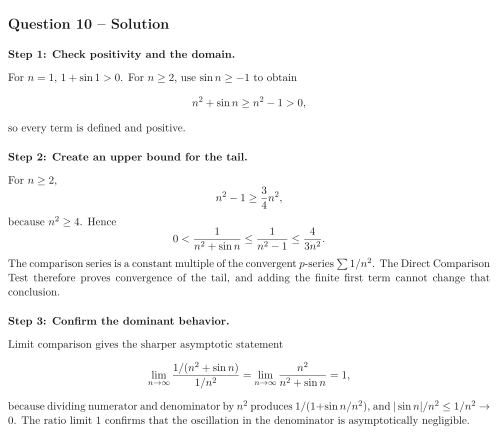
Question 10 – Solution
Step 1: Check positivity and the domain.
For , . For , use to obtain so every term is defined and positive.
Step 2: Create an upper bound for the tail.
For , because . Hence The comparison series is a constant multiple of the convergent -series . The Direct Comparison Test therefore proves convergence of the tail, and adding the finite first term cannot change that conclusion.
Step 3: Confirm the dominant behavior.
Limit comparison gives the sharper asymptotic statement because dividing numerator and denominator by produces , and . The ratio limit confirms that the oscillation in the denominator is asymptotically negligible.