Question 6
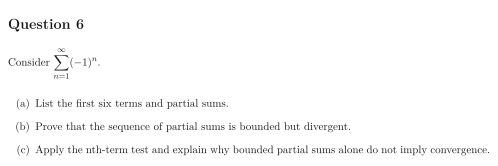
Consider .
List the first six terms and partial sums.
Prove that the sequence of partial sums is bounded but divergent.
Apply the nth-term test and explain why bounded partial sums alone do not imply convergence.
Show solutionHide solution
Question 6 – Solution
Step 1: Distinguish terms from partial sums.
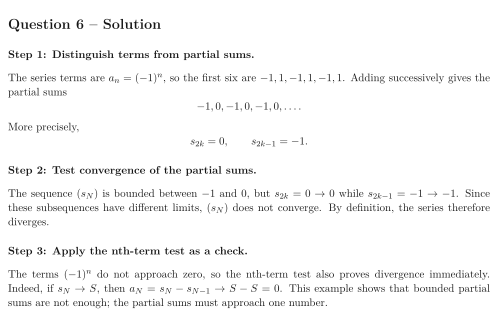
The series terms are , so the first six are . Adding successively gives the partial sums More precisely,
Step 2: Test convergence of the partial sums.
The sequence is bounded between and , but while . Since these subsequences have different limits, does not converge. By definition, the series therefore diverges.
Step 3: Apply the nth-term test as a check.
The terms do not approach zero, so the nth-term test also proves divergence immediately. Indeed, if , then . This example shows that bounded partial sums are not enough; the partial sums must approach one number.