More on Sequences — Question 10

PDF ↗

Question 10

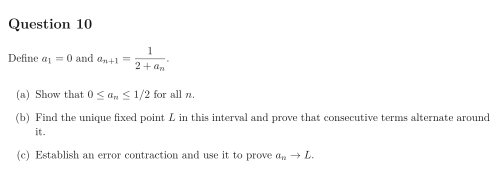
Define a1=0a_1=0 and an+1=12+ana_{n+1}=\dfrac1{2+a_n}.

  1. Show that 0≤an≤1/20\le a_n\le1/2 for all nn.

  2. Find the unique fixed point LL in this interval and prove that consecutive terms alternate around it.

  3. Establish an error contraction and use it to prove an→La_n\to L.

Original worksheet page 1: question and worked solution for 4-2-010
Show solutionHide solution

Question 10 – Solution

Step 1: Establish an invariant interval.

The bound follows by induction. The base case a1=0a_1=0 lies in [0,1/2][0,1/2]. If 0≤an≤1/20\le a_n\le1/2, then 2+an≥22+a_n\ge2, so 0<an+1=1/(2+an)≤1/20<a_{n+1}=1/(2+a_n)\le1/2. Hence every term remains in [0,1/2][0,1/2].

Step 2: Find the admissible fixed point.

A fixed point satisfies L=12+L⇔L2+2L−1=0,L=\frac1{2+L}\iff L^2+2L-1=0, so L=−1±2L=-1\pm\sqrt2. Only L=2−1L=\sqrt2-1 lies in the invariant interval [0,1/2][0,1/2].

Step 3: Explain the alternating behavior.

Let f(x)=1/(2+x)f(x)=1/(2+x). Because f′(x)=−1/(2+x)2<0f'(x)=-1/(2+x)^2<0, ff is strictly decreasing. Since a1<La_1<L, a2=f(a1)>f(L)=La_2=f(a_1)>f(L)=L. Applying the decreasing map reverses the side of LL at every iteration, so successive terms alternate across the fixed point.

Step 4: Prove convergence with an error contraction.

|an+1−L|=|12+an−12+L|=|an−L|(2+an)(2+L)≤14|an−L|.|a_{n+1}-L|=\left|\frac1{2+a_n}-\frac1{2+L}\right| =\frac{|a_n-L|}{(2+a_n)(2+L)}\le\frac14|a_n-L|. Both denominator factors are at least 22, which justifies the factor 1/41/4. Iterating gives |an−L|≤(14)n−1|a1−L|→0.|a_n-L|\le\left(\frac14\right)^{n-1}|a_1-L|\longrightarrow0. Therefore an→2−1a_n\to\sqrt2-1; the even and odd subsequences approach the same value from opposite sides.
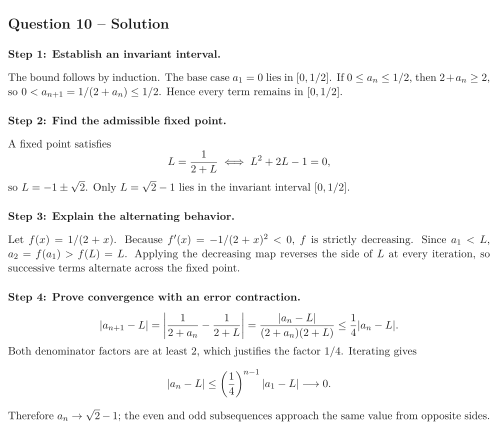
Original worksheet page 2: question and worked solution for 4-2-010

Original worksheet layout. Use Enlarge or open the PDF for a closer view.