Question 8
Let be a nonnegative integer. Explain algebraically why the generalized binomial series for terminates, and recover the ordinary finite Binomial Theorem. Illustrate with .

Show solutionHide solution
Question 8 – Solution
Step 1: Examine the generalized coefficient.
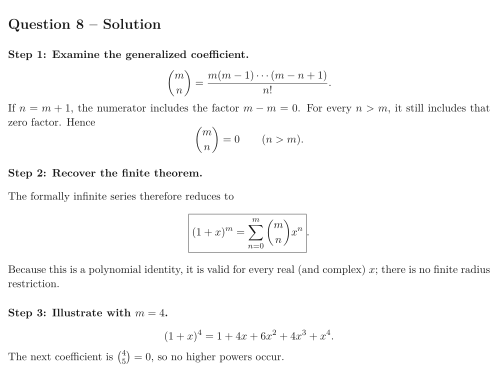
If , the numerator includes the factor . For every , it still includes that zero factor. Hence
Step 2: Recover the finite theorem.
The formally infinite series therefore reduces to Because this is a polynomial identity, it is valid for every real (and complex) ; there is no finite radius restriction.
Step 3: Illustrate with .
The next coefficient is , so no higher powers occur.