Question 6
For , compare the linear approximation with . Decide whether overestimates or underestimates, and use the alternating series to bound the absolute error.

Show solutionHide solution
Question 6 – Solution
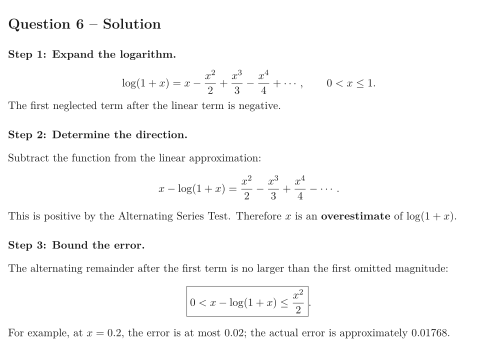
Step 1: Expand the logarithm.
The first neglected term after the linear term is negative.
Step 2: Determine the direction.
Subtract the function from the linear approximation: This is positive by the Alternating Series Test. Therefore is an overestimate of .
Step 3: Bound the error.
The alternating remainder after the first term is no larger than the first omitted magnitude: For example, at , the error is at most ; the actual error is approximately .