Taylor Series — Question 2

PDF ↗

Question 2

Derive the Maclaurin series for sin⁡x\sin x from its derivative cycle. Explain why only odd powers occur, give the degree-77 polynomial, and state the convergence domain.

Original worksheet page 1: question and worked solution for 4-16-002
Show solutionHide solution

Question 2 – Solution

Step 1: List the derivative cycle.

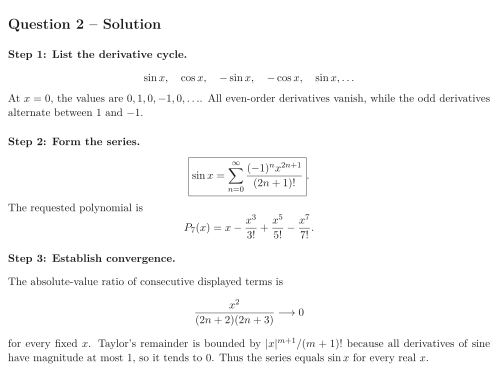
sin⁡x,cos⁡x,−sin⁡x,−cos⁡x,sin⁡x,…\sin x,\quad \cos x,\quad-\sin x,\quad-\cos x,\quad\sin x,\ldots At x=0x=0, the values are 0,1,0,−1,0,…0,1,0,-1,0,\ldots. All even-order derivatives vanish, while the odd derivatives alternate between 11 and −1-1.

Step 2: Form the series.

sin⁡x=∑n=0∞(−1)nx2n+1(2n+1)!.\boxed{\sin x=\sum_{n=0}^{\infty}\frac{(-1)^n x^{2n+1}}{(2n+1)!}}. The requested polynomial is P7(x)=x−x33!+x55!−x77!.P_7(x)=x-\frac{x^3}{3!}+\frac{x^5}{5!}-\frac{x^7}{7!}.

Step 3: Establish convergence.

The absolute-value ratio of consecutive displayed terms is x2(2n+2)(2n+3)→0\frac{x^2}{(2n+2)(2n+3)}\longrightarrow0 for every fixed xx. Taylor’s remainder is bounded by |x|m+1/(m+1)!|x|^{m+1}/(m+1)! because all derivatives of sine have magnitude at most 11, so it tends to 00. Thus the series equals sin⁡x\sin x for every real xx.

Original worksheet page 2: question and worked solution for 4-16-002

Original worksheet layout. Use Enlarge or open the PDF for a closer view.