Question 3
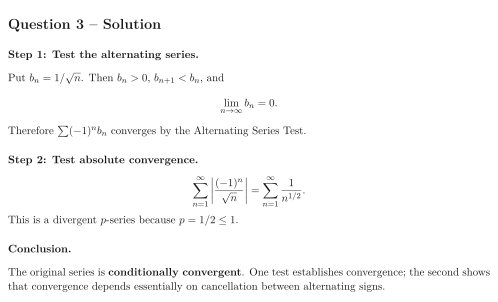
Classify as absolutely convergent, conditionally convergent, or divergent. Use separate tests for ordinary and absolute convergence.
Show solutionHide solution
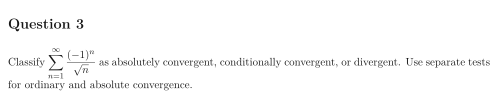
Question 3 – Solution
Step 1: Test the alternating series.
Put . Then , , and Therefore converges by the Alternating Series Test.
Step 2: Test absolute convergence.
This is a divergent -series because .
Conclusion.
The original series is conditionally convergent. One test establishes convergence; the second shows that convergence depends essentially on cancellation between alternating signs.