Root Test — Question 7

PDF ↗

Question 7

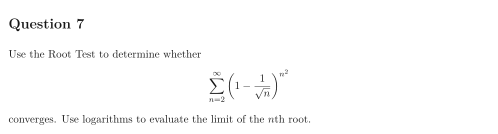
Use the Root Test to determine whether ∑n=2∞(1−1n)n2\sum_{n=2}^{\infty}\left(1-\frac1{\sqrt n}\right)^{n^2} converges. Use logarithms to evaluate the limit of the nnth root.

Original worksheet page 1: question and worked solution for 4-11-007
Show solutionHide solution

Question 7 – Solution

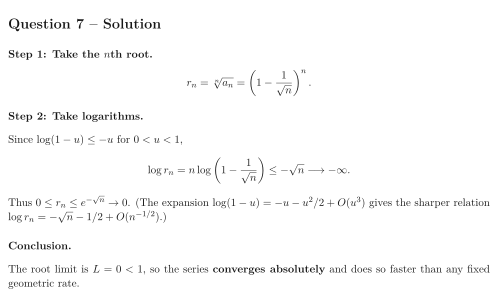
Step 1: Take the nnth root.

rn=ann=(1−1n)n.r_n=\sqrt[n]{a_n}=\left(1-\frac1{\sqrt n}\right)^n.

Step 2: Take logarithms.

Since log⁡(1−u)≤−u\log(1-u)\le-u for 0<u<10<u<1, log⁡rn=nlog⁡(1−1n)≤−n→−∞.\log r_n=n\log\left(1-\frac1{\sqrt n}\right)\le -\sqrt n\longrightarrow-\infty. Thus 0≤rn≤e−n→00\le r_n\le e^{-\sqrt n}\to0. (The expansion log⁡(1−u)=−u−u2/2+O(u3)\log(1-u)=-u-u^2/2+O(u^3) gives the sharper relation log⁡rn=−n−1/2+O(n−1/2)\log r_n=-\sqrt n-1/2+O(n^{-1/2}).)

Conclusion.

The root limit is L=0<1L=0<1, so the series converges absolutely and does so faster than any fixed geometric rate.

Original worksheet page 2: question and worked solution for 4-11-007

Original worksheet layout. Use Enlarge or open the PDF for a closer view.