Root Test — Question 5

PDF ↗

Question 5

Determine whether ∑n=2∞(log⁡nn)n\sum_{n=2}^{\infty}\left(\frac{\log n}{n}\right)^n converges or diverges. Compute the Root Test limit and interpret what a limit of zero implies.

Original worksheet page 1: question and worked solution for 4-11-005
Show solutionHide solution

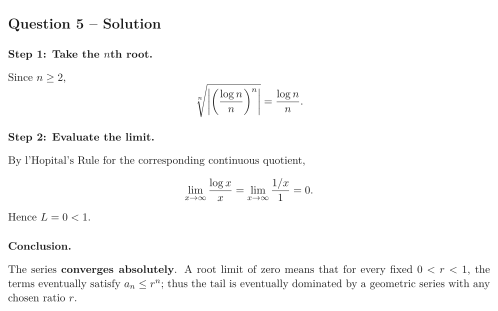
Question 5 – Solution

Step 1: Take the nnth root.

Since n≥2n\ge2, |(log⁡nn)n|n=log⁡nn.\sqrt[n]{\left|\left(\frac{\log n}{n}\right)^n\right|}=\frac{\log n}{n}.

Step 2: Evaluate the limit.

By l’Hopital’s Rule for the corresponding continuous quotient, limx→∞log⁡xx=limx→∞1/x1=0.\lim_{x\to\infty}\frac{\log x}{x}=\lim_{x\to\infty}\frac{1/x}{1}=0. Hence L=0<1L=0<1.

Conclusion.

The series converges absolutely. A root limit of zero means that for every fixed 0<r<10<r<1, the terms eventually satisfy an≤rna_n\le r^n; thus the tail is eventually dominated by a geometric series with any chosen ratio rr.

Original worksheet page 2: question and worked solution for 4-11-005

Original worksheet layout. Use Enlarge or open the PDF for a closer view.